
Princes Got One Day Off a Year
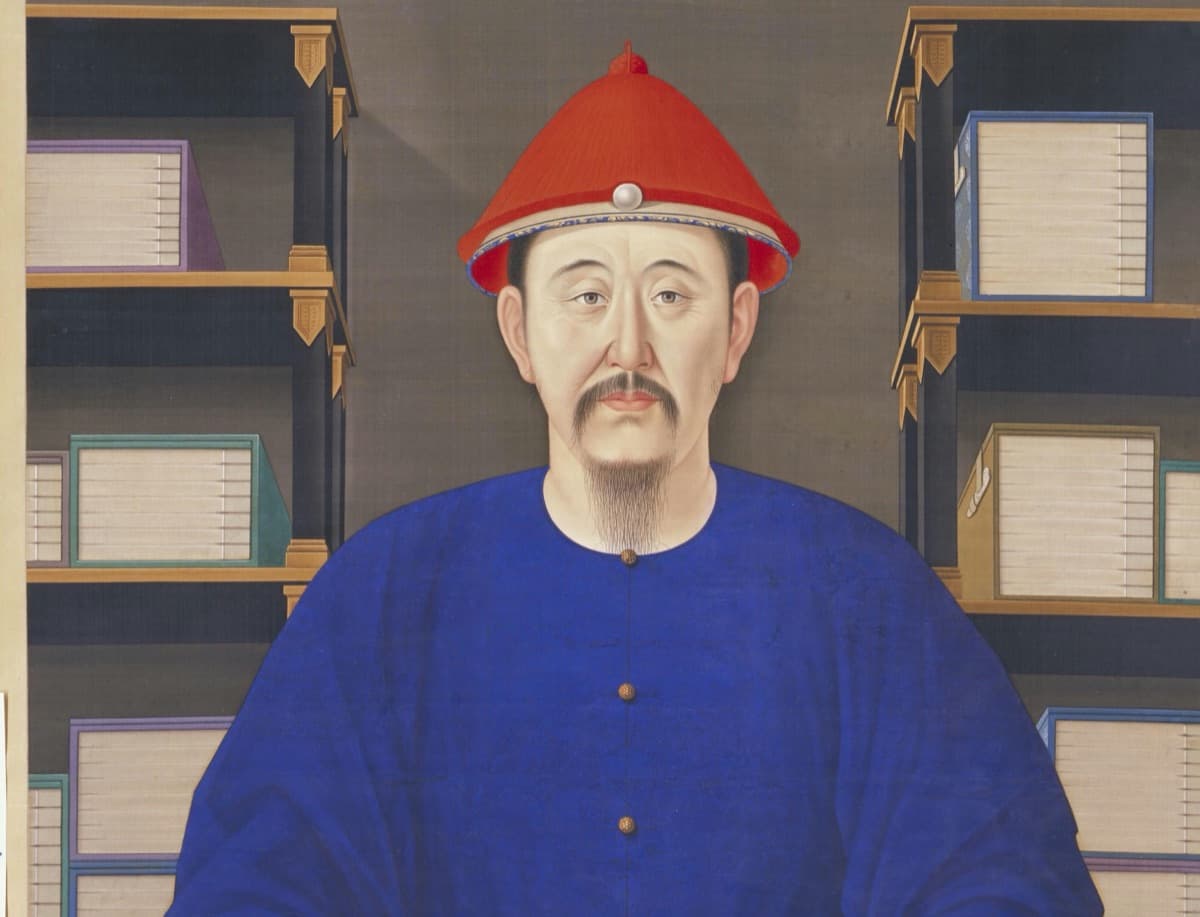
Table of Content
- I. Hardship first
- 逸 — The Duke of Zhou's first lesson for his nephew: know how hard farming is
- 績 — The chancellor's mother was still spinning her own thread
- 財 — The crown prince's tutor retired and spent every ounce of the gift
- 履 — A young aristocrat is humiliated by an old man, three times
- 簡 — Two bamboo slips, a three-year test
- 雞 — Up at the cock's crow to practise with the sword
- 飯 — Tang Taizong asks the crown prince at dinner: do you know what this rice is?
- 田 — The Ming founder sends his thirteen-year-old heir out to walk the fields
- 勞 — Kangxi: a man who has only known ease cannot even bear being tired
- 寅 — Princes got one day off a year
- II. Nerve
- 獵 — Hunting was military training
- 戈 — The noble child's timetable: boarding at ten, no silk
- 兵 — Gao Huan sends armoured cavalry to fake-ambush his own sons
- 將 — Cao Cao asks his sons what they want to be
- 殤 — A boy dies in battle, and Confucius says: do not bury him as a child
- 暇 — Aristocratic courage was called "unhurried"
- 射 — Kangxi: the man who taught me archery never once praised me
- III. Competence
- 質 — Chulong to the Queen Dowager: if you do not let your son earn merit, you are ruining him
- 刀 — Zichan: he cannot hold a knife yet, and you want him to carve
- 藝 — Deng Yu's thirteen sons, one skill each
- 令 — Cao Cao's order: being loved as a child counts for nothing; I use the one who grows up able
- 遠 — Confucius did not teach his own son
- 友 — Jingjiang takes one look at her son's friends
- IV. Do it the other way round, and the ending is already written
- 寵 — Shi Que: pride, extravagance, licence and idleness all come from indulgence
- 獄 — What Zhao Gao taught Huhai was how to cut people up
- 粉 — The young lords of Liang: perfumed, powdered, and mistook a horse for a tiger
- 冰 — A ten-year-old prince throws a tantrum over ice
- What changed in three thousand years, and what did not
- How these were checked
Start with a fact that will make a lot of parents uncomfortable.
A prince of the Qing dynasty began school at six. He was in the schoolroom between three and five in the morning and left between three and five in the afternoon. He got one day off a year — New Year's Day. This is not legend. Three men who served inside the palace wrote it down, separately.
When people say "aristocratic education" today, they picture piano, horses and table manners. Open the old books and you find that China's nobles taught their children something else first: how to suffer.
"Noble" is used loosely here — the sons of Zhou lords and hereditary ministers, the meritorious families and imperial in-laws of the Han, the great clans of the Six Dynasties, the princes, generals and chancellors of Tang, Song, Ming and Qing. They shared one problem. Their children were born with everything. How you make a child who has everything grow a spine, a nerve and a skill is a question these families worked on for three thousand years.
Everything below is something they actually did. Each item comes with the sentence it comes from, in the original, so you can check it yourself.
I. Hardship first
逸 — The Duke of Zhou's first lesson for his nephew: know how hard farming is
The Duke of Zhou governed for the boy-king Cheng and wrote him an essay on how to rule. Its first sentence is not about ritual or the Mandate of Heaven. It is about farming.
The essay is called Against Idleness (無逸). Look at the common people, the Duke says: the parents sweat in the fields, and the son, who has never known how hard it is, lives soft, talks big and sneers that the old folks know nothing. Then he runs through the good kings of the Shang. King Wuding, as crown prince, "laboured long outside, among the common people," and reigned fifty-nine years. The kings who came after were born into ease, and their reigns shrank to "ten years, or seven or eight, or five or six, or three or four."
The essay became the standard text for teaching heirs. A thousand and more years later, Tang Taizong and the founder of the Ming were still quoting it to their sons.
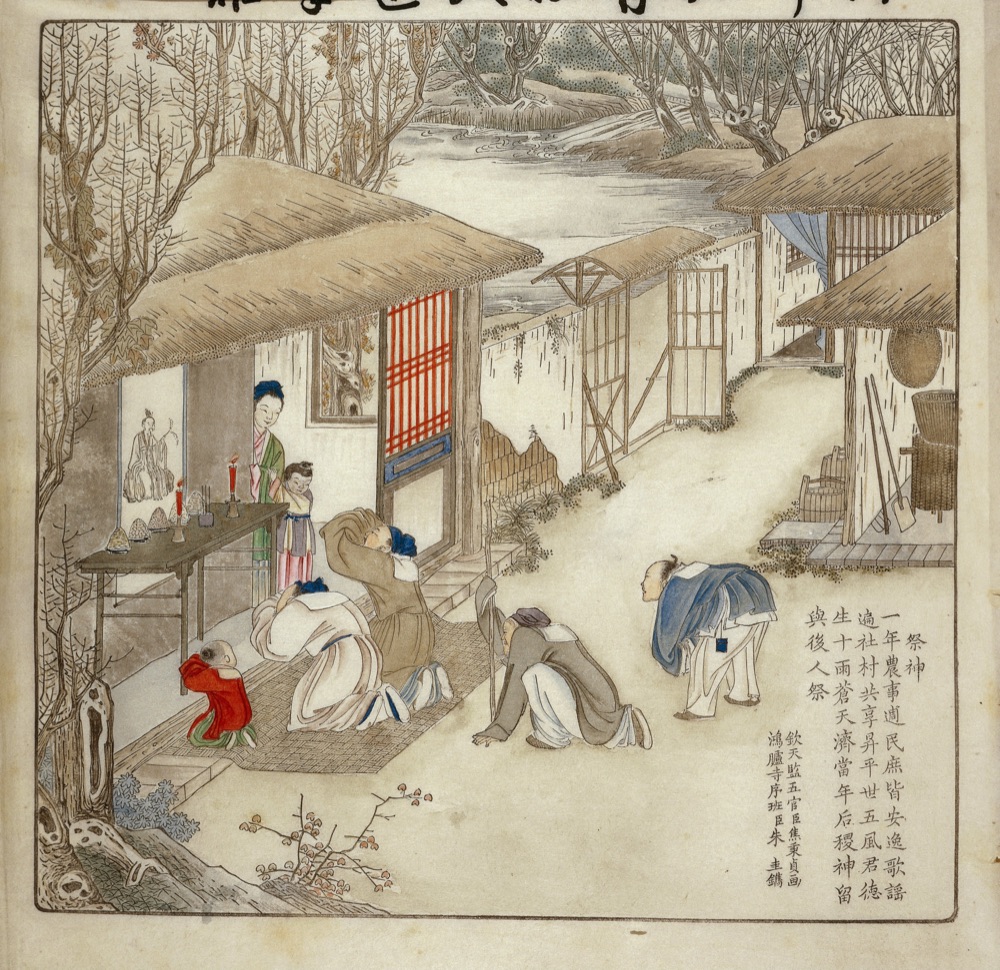
Emperors kept using the lesson. In 1696 the Kangxi Emperor commissioned the court painter Jiao Bingzhen to make forty-six Pictures of Tilling and Weaving and wrote a poem on each. This leaf is "Sacrifice to the Spirits": harvest in, a farming family gives thanks at the door. British Museum · public domain.
先知稼穡之艱難,乃逸,則知小人之依。
"First know how hard it is to sow and reap; then take your ease, and you will know what the common people live on."
— 《尚書·無逸》 Book of Documents, "Against Idleness" · found in 127 books
其在高宗,時舊勞于外,爰暨小人。
"As for Wuding: he laboured long outside, together with the common people."
— 《尚書·無逸》 Book of Documents · found in 114 books
績 — The chancellor's mother was still spinning her own thread
Gongfu Wenbo, a minister of Lu, came home from court and found his mother Jingjiang spinning hemp. He said: a house like ours, and you still spin — the head of the Ji clan will think I am a bad son.
She sighed. Lu is finished, she said, if boys like you hold office and nobody has taught you anything. Then she gave him the fullest statement of a work ethic that survives from the early aristocracy. The sage kings deliberately settled people on poor land, because "the people of rich soil are good for nothing." She went down the whole hierarchy, from the Son of Heaven to the peasants, and set out what each had to do every day. Her conclusion: "from the commoners down, up at dawn, rest at dark, not one day idle." Nobody had the right to be lazy.
When Confucius heard of it he said: disciples, write this down — the lady of the Ji house does not indulge herself.
夫民勞則思,思則善心生;逸則淫,淫則忘善,忘善則惡心生。
"When people labour they think, and thinking breeds good intentions. When they are idle they run loose; running loose they forget the good, and forgetting the good breeds bad intentions."
— 《國語·魯語下》 Discourses of the States, 4th c. BCE · found in 80 books
君子能勞,後世有繼。
"A gentleman who can bear hardship will have descendants to carry on." Jingjiang is quoting her mother-in-law.
— 《國語·魯語下》 Discourses of the States · found in 25 books
財 — The crown prince's tutor retired and spent every ounce of the gift
Shu Guang, Grand Tutor to the heir of Emperor Xuan of Han, retired with seventy catties of gold from the emperor and the prince. Back in his home town he threw feasts for clan and neighbours day after day, and kept asking how much gold was left so he could sell it and feast again.
His descendants panicked and sent an old friend to plead: at least buy some land and a house. His reply has been used on rich men's children ever since.
賢而多財,則損其志;愚而多財,則益其過。
"A capable son with too much money loses his ambition. A foolish son with too much money multiplies his faults."
— 《漢書·疏廣傳》 Book of Han, 1st c. CE · found in 75 books
He went on: there are old fields and an old house; let the children work them, eat and dress like everyone else. Give them more and you only teach them idleness.
履 — A young aristocrat is humiliated by an old man, three times
Zhang Liang came from five generations of chancellors of Han (the state, not the dynasty). As a young man he spent the family fortune hiring an assassin to kill the First Emperor, failed, and fled to Xiapi.
One day on a bridge, an old man in rough cloth walked up, kicked his shoe off the bridge and said: boy, go down and get my shoe. Zhang Liang froze; he wanted to hit him. Seeing the man was old, he held it in and fetched the shoe. Put it on me, said the old man. Zhang Liang knelt and put it on. The old man laughed and left.
A li down the road he came back. You can be taught, he said. Meet me here at dawn in five days. Zhang Liang came at dawn; the old man was already there and scolded him for being late. Again in five days. The second time he came at cockcrow — still late. The third time he went before midnight and waited. When the old man arrived he said: that is how it should be. And gave him a book on war.
Su Shi, a thousand years later, wrote an essay on this. The book, he said, was never the point. Zhang Liang had more than enough talent and not enough patience; the old man was there to "break the sharp edge of his youth," to turn a boy who only knew how to draw a sword into a man who could wait. He added: the whole difference between Liu Bang, who won, and Xiang Yu, who lost, lay in being able to hold back. Zhang Liang taught Liu Bang that.
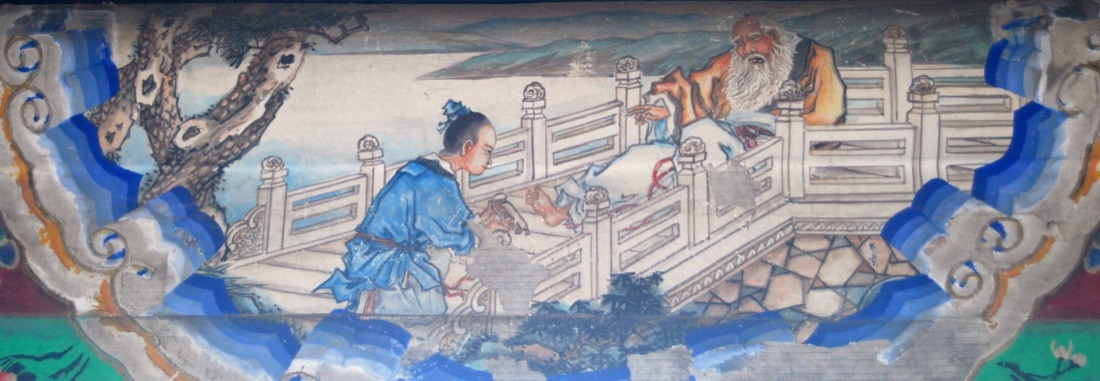
The old man on the bridge, the shoe below it. Zhang Liang Presents the Shoe, a painted panel from the Long Corridor at the Summer Palace, Beijing, late 19th century. China has painted this scene for two thousand years, and it never paints the book — always the bow. Photo by shizhao · public domain.
良鄂然,欲毆之。為其老,彊忍,下取履。
"Liang was stunned and wanted to strike him. Because the man was old, he forced himself to hold back, and went down for the shoe."
— 《史記·留侯世家》 Records of the Grand Historian, c. 90 BCE · found in 186 books
夫老人者,以為子房才有餘,而憂其度量之不足,故深折其少年剛銳之氣,使之忍小忿而就大謀。
"The old man judged that Zifang had talent to spare but lacked breadth, so he broke the sharp edge of his youth, hard, to make him swallow small anger for the sake of great plans."
— 蘇軾《留侯論》 Su Shi, On the Marquis of Liu, 11th c. · found in 12 books
The counter-example is Xiang Yu. His family had produced Chu's generals for generations and his uncle taught him personally. Writing — he did not finish. Sword — he did not finish. When his uncle lost his temper, he said a sword only beats one man; he wanted to learn to beat ten thousand. So his uncle taught him strategy. He "grasped the general idea, and again would not finish."
項籍少時,學書不成,去學劍,又不成。
"As a boy Xiang Ji studied writing and did not master it; he turned to the sword and did not master that either."
— 《史記·項羽本紀》 Records of the Grand Historian · found in at least 2 books
簡 — Two bamboo slips, a three-year test
Zhao Jianzi was the most powerful minister of Jin at the end of the Spring and Autumn period. To choose an heir between two sons he wrote the same admonition on two bamboo slips, gave each boy one, and said: remember this.
Three years later he asked. The elder, Bolu, could not recite it and had lost the slip. The younger, Wuxu, recited it fluently and drew the slip from his sleeve.
Wuxu was named heir. He became Zhao Xiangzi, who destroyed the Zhi clan and laid the foundation of the state of Zhao. The test was not of cleverness. It was of three years without slackening.
三年而問之,伯魯不能舉其辭,求其簡,已失之矣。問無恤,誦其辭甚習,求其簡,出諸袖中而奏之。
"After three years he asked. Bolu could not say the words and had lost the slip. Wuxu recited them with ease and produced the slip from his sleeve."
— 《資治通鑑》 Zizhi Tongjian, 1084 · found in 18 books
雞 — Up at the cock's crow to practise with the sword
Zu Ti came from a leading northern clan — "officials of two thousand bushels for generations," the equivalent of senior provincial rank. At fourteen or fifteen he still cared nothing for books and his elder brothers worried about him. Later, serving alongside Liu Kun and sharing a bed with him, he heard a wild cock crow in the middle of the night, kicked Liu Kun awake and said: that is not a bad omen. The two got up and practised with their swords.
Tao Kan, as governor of Guangzhou with nothing to do, carried a hundred bricks out of his study every morning and carried them back in every evening. Asked why, he said: I mean to recover the Central Plain. If I live too comfortably now, I will not be able to bear the work when it comes.
中夜聞荒雞鳴,蹴琨覺曰:此非惡聲也。因起舞。
"In the middle of the night he heard a wild cock crow, kicked Kun awake and said: this is no ill sound. And they rose to dance with swords."
— 《晉書·祖逖傳》 Book of Jin, 648 · found in 61 books
吾方致力中原,過爾優逸,恐不堪事。
"I am about to give myself to the Central Plain. Living this easy, I fear I will not be equal to the task."
— 《晉書·陶侃傳》 Book of Jin · found in 44 books
飯 — Tang Taizong asks the crown prince at dinner: do you know what this rice is?
Tang Taizong told the crown prince's tutors: at eighteen I was still living among the people and knew every hardship they had; the prince grew up in the palace and has seen none of it.
In 644 he said: the ancients practised prenatal education; I had no time for that. But since I named the heir I have used whatever is in front of us. At dinner I ask, do you know what rice is? On horseback, do you know what a horse is? In a boat, do you know what a boat is? Resting under a crooked tree, do you know what this tree is?
The prince said "no" every time. Then the emperor explained.
見其臨食將飯,謂曰:汝知飯乎?對曰:不知。曰:凡稼穡艱難,皆出人力,不奪其時,常有此飯。
"Seeing him about to eat, he asked: do you know what rice is? No. He said: all the hardship of sowing and reaping comes from human labour. Do not take the people's time, and there will always be this rice."
— 《貞觀政要·教戒太子諸王》 Essentials of Government of the Zhenguan Era, early 8th c. · found in 5 books
The horse "bears men's toil"; do not use up its strength. The boat is the ruler, the water the people; water carries the boat and can overturn it. A crooked tree is straightened by the carpenter's line; a muddled ruler is made wise by taking advice.
田 — The Ming founder sends his thirteen-year-old heir out to walk the fields
In the tenth month of 1367 Zhu Yuanzhang was not yet emperor; his armies were marching north. He summoned his eldest son Zhu Biao, thirteen, and his second son Zhu Shuang, twelve, and sent them to the family tombs at Linhao. His parting words are Against Idleness in plain speech.
Why, he asked, are Wuding of Shang and King Cheng of Zhou called good rulers? Because one "laboured long outside and knew the people's suffering," and the other heard Against Idleness as a boy. You were born into wealth and have never known hardship; a man grows proud and lazy in comfort. So go to the nearby prefectures, walk and look.
因道途之險易以知鞍馬之勤勞,觀小民之生業以知衣食之艱難,察民情之好惡以知風俗之美惡。
"From the hard and easy stretches of the road, learn how wearying the saddle is. From watching how small people earn their living, learn how hard food and clothing come. From the likes and dislikes of the people, learn which customs are good and which are bad."
— 《明太祖實錄》 Veritable Records of Ming Taizu, entry for 1367 · found in 7 books
And when you reach the tombs, find the old men and ask them about the days when I raised an army and crossed the river. Remember it, so you know how hard it was to build this.
勞 — Kangxi: a man who has only known ease cannot even bear being tired
The Kangxi Emperor left his sons a book of Family Instructions. One entry turns three thousand years of "against idleness" into plain talk.
The man who said it. The Kangxi Emperor Reading, hanging scroll, 1699, when he was forty-five. A wall of books behind him, one open on his knee. Palace Museum, Beijing · public domain.
世人皆好逸而惡勞,朕心則謂人恆勞而知逸。若安於逸,則不惟不知逸,而遇勞即不能堪矣。……聖人以勞為福,以逸為禍也。
"Everyone loves ease and hates toil. My view is that a man must toil constantly to know what ease is. One who settles into ease not only never knows ease — the moment toil comes, he cannot bear it. … The sages took toil for a blessing and ease for a curse."
— 《聖祖仁皇帝庭訓格言》 Maxims from the Kangxi Emperor's Family Instructions, compiled 1730 · found in 2 books
The same book has a very concrete entry: people of rank can sit upright for hours. Kangxi says that from the day he took the throne as a child to old age — in council with ministers, discussing books with scholars, chatting with his own family — he always "sat bolt upright," and that this was "formed in childhood." He quotes Confucius: what is formed young is like nature; habit is like instinct.
To the officials running a military examination he put it more bluntly:
凡人必耐得勞苦,乃能有成。不耐勞苦,到處無用。
"A man must be able to endure hardship before he can achieve anything. One who cannot is useless anywhere."
— 《清聖祖實錄》 Veritable Records of the Kangxi Reign · found in 5 books
寅 — Princes got one day off a year
Three Qing memoirs, three angles, one timetable.
Zhaolian was a prince of the blood. He wrote: in this dynasty a prince enters the Upper Study at six. The study is to the left of the Qianqing Palace, close to the emperor so he can check on it at any time. The rule is in at the hour of mao (five to seven in the morning), out at the hour of shen (three to five in the afternoon). The curriculum is the Five Classics, the Records and the Han History, policy essays and poetry; the examination-style eight-legged essay is forbidden. The daily poetry exercise "does not stop for the deepest cold or the fiercest heat."
Wu Zhenyu gives more detail: the prince arrives at the hour of yin — three to five in the morning — and studies Manchu and Mongolian first, Chinese only afterwards. The only holiday in the year is New Year's Day; on New Year's Eve and the day before, school lets out mid-morning. Princes and great ministers kneel on both knees when they see a prince; only the Upper Study tutors greet him with folded hands and do not kneel.
Zhao Yi worked the early shift at the Grand Council and wrote what he saw: into the palace at the fifth watch, not one official from the ministries yet arrived, himself dozing against a pillar — and far off, a single white gauze lantern passing through the Longzong Gate. That was a prince going to his lessons.
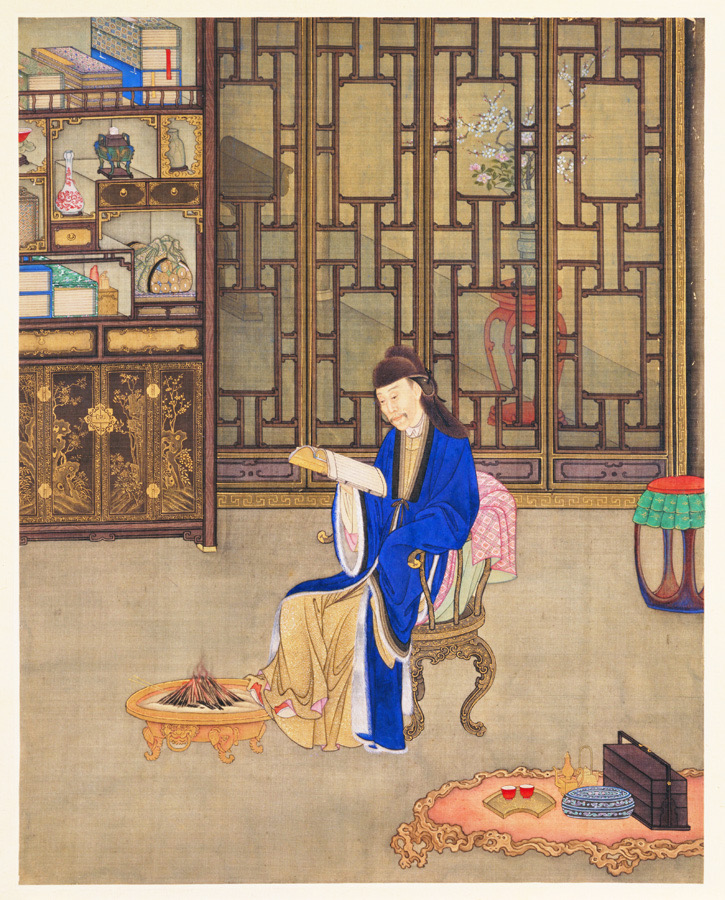
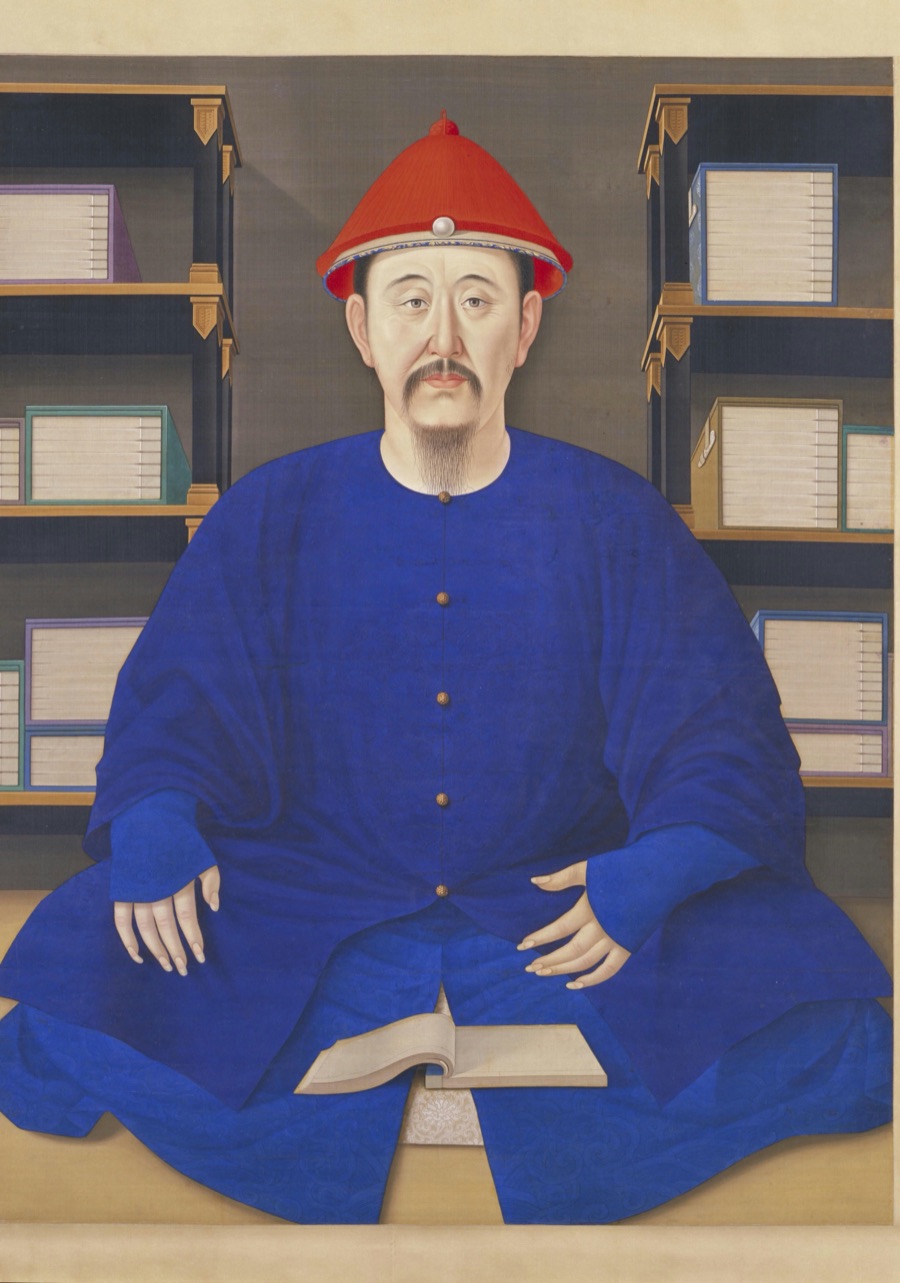
One who came out of that schoolroom. The Yongzheng Emperor Reading, by a Qing court painter. Yongzheng was Kangxi's fourth son; this is him in his study. Public domain, via Wikimedia Commons.
寅刻至書房,先習滿洲、蒙古文畢,然後習漢書。……惟元旦免入直,除夕及前一日,巳刻准散直。
"At the hour of yin he arrives at the schoolroom and first finishes Manchu and Mongolian, then studies Chinese. … Only on New Year's Day is attendance excused; on New Year's Eve and the day before, dismissal is permitted at the hour of si" — nine to eleven in the morning.
— 吳振棫《養吉齋叢錄》 Wu Zhenyu, Collected Notes from the Yangji Studio, 19th c. · found in 1 book
定制,卯入申出……日課詩賦,雖窮寒盛暑不輟。
"By rule, in at mao and out at shen … the daily poetry exercise did not stop for the deepest cold or the fiercest heat."
— 昭槤《嘯亭雜錄》 Zhaolian, Miscellaneous Notes from the Whistling Pavilion, early 19th c. · found in 9 books
吾輩窮措大專恃讀書為衣食者,尚不能早起,而天家金玉之體乃日日如是。
"We poor scholars, who live by nothing but our books, cannot get up this early — and the gold-and-jade bodies of the imperial house do it every single day."
— 趙翼《簷曝雜記》 Zhao Yi, Notes Written in the Sun under the Eaves, late 18th c. · found in 1 book
Zhao Yi could not resist a comparison with the Ming: their princes began lessons in their teens, the tutor lectured for a moment and left, and the rest of the day was spent with eunuchs and palace women.
II. Nerve
獵 — Hunting was military training
You assume the aristocratic hunt was recreation.
It was not. Spring hunt, summer hunt, autumn hunt, winter hunt — each had its own name, each fell in the slack season of the farming year, and the purpose was "to drill." Afterwards the ranks were reformed, victory rites performed, the game counted, seats assigned by merit, high and low and old and young sorted out. This was a review of the army, not a day out. When Duke Yin of Lu wanted to go and watch some fishermen, his minister Zang Xibo talked him out of it with exactly this argument: it is not drill, so a ruler has no business there.
Tang Taizong's Model for an Emperor, written for his heir, has a chapter titled "Reviewing the Troops." It repeats "drill in the farming off-season" and quotes Confucius: to send people to war untrained is to throw them away.
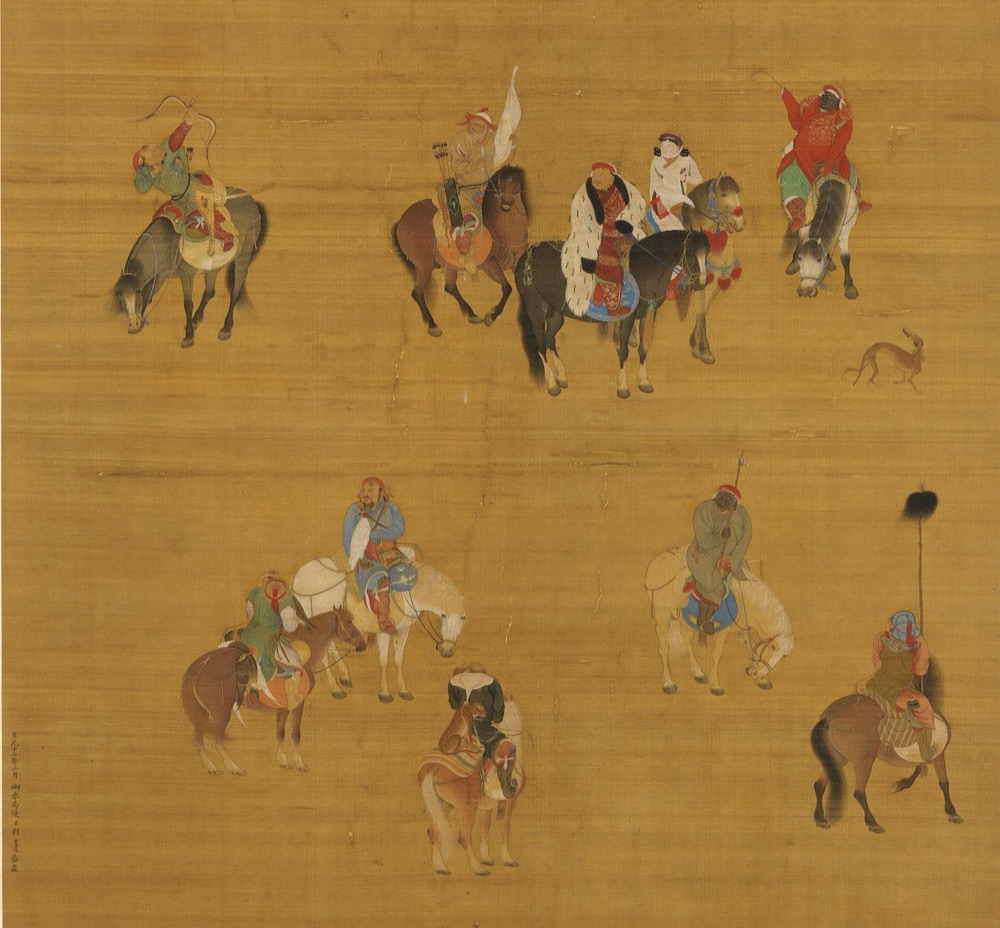
The whole household rode out. Liu Guandao, Khubilai Khan Hunting, detail, 1280. Khubilai in white fur on horseback, surrounded by archers, a falconer and a hunting cheetah. National Palace Museum, Taipei · public domain.
故春蒐夏苗,秋獮冬狩,皆於農隙以講事也。三年而治兵,入而振旅,歸而飲至,以數軍實。
"So the spring sou, summer miao, autumn xian and winter shou hunts are all held in the farming off-season, to drill. Every three years the army is mustered; it returns in formation, drinks the rite of return, and counts its spoils."
— 《左傳·隱公五年》 Zuo Tradition, 4th c. BCE · found in 119 books
戈 — The noble child's timetable: boarding at ten, no silk
The Book of Rites preserves a growth chart for Zhou noble children, year by year.
At six, counting and the names of the directions. At seven, boys and girls no longer share a mat. At eight, they let elders go first through doors and at meals; they begin to learn to yield. At nine, the calendar. At ten, the boy leaves home to board with a tutor, learns writing and record-keeping, and is not allowed silk underclothes. At thirteen, music, reciting the Odes, the civil dance. At fifteen, the military dance, archery and charioteering. At twenty, the capping ceremony — and only now may he wear silk and fur.
The Summary of Ritual adds a line: "a child does not wear fur or skirts." From ten to twenty, no silk and no fur on a noble boy.
The "shield and dagger-axe" on the curriculum were real weapons, learned in spring and summer; "feather and flute" was the civil dance, learned in autumn and winter. Half the year went to the war dance. The Rites of Zhou lists the six arts in full: five styles of archery, five of charioteering — one of them, "following the bends of the water," meant driving at speed along a winding riverbank without going in.
And one line that is surprising today: the king's heir, the heirs of the feudal lords, the eldest sons of ministers, and the best young men selected from the commoners all attended the same school, seated by age, not by birth.
十年,出就外傅,居宿於外,學書記,衣不帛襦褲……十有三年,學樂誦詩,舞勺,成童,舞象,學射御。
"At ten he goes out to a tutor and boards away from home, studies writing and reckoning, and wears no silk jacket or trousers … At thirteen he studies music, recites the Odes, dances the shao; at fifteen he dances the xiang and learns archery and charioteering."
— 《禮記·內則》 Book of Rites, "Pattern of the Family" · found in at least 240 books
凡學世子,及學士,必時。春夏學干戈,秋冬學羽籥。
"Teaching the heir and the young nobles always follows the seasons: shield and dagger-axe in spring and summer, feather and flute in autumn and winter."
— 《禮記·文王世子》 Book of Rites, "King Wen as Heir" · found in 108 books
王大子,王子,群后之大子,卿大夫元士之適子,國之俊選,皆造焉。凡入學以齒。
"The king's heir, the king's sons, the heirs of the lords, the eldest sons of ministers and officers, and the chosen talents of the state all go there. Everyone who enters is ranked by age."
— 《禮記·王制》 Book of Rites, "Royal Regulations" · found in 45 books
兵 — Gao Huan sends armoured cavalry to fake-ambush his own sons
Gao Huan was the real ruler of the Eastern Wei and the founder of the house of Northern Qi. To test his sons' heads and nerves he set them two trials.
First: each got a tangle of silk thread to sort out. While the others picked at theirs, the second son Gao Yang drew his sword and cut it through — "what is tangled should be cut." Gao Huan nodded.
Second: each son was given a troop and sent out of the city by a different road, and the general Peng Le was sent after them with armoured cavalry to stage an attack. The eldest, Gao Cheng, and the rest panicked. Gao Yang formed his men and fought; when Peng Le took off his helmet and explained it was an exercise, Gao Yang arrested him anyway and brought him in.
Gao Huan told his chief of staff: this boy's head is better than mine.
又各配兵四出,而使甲騎偽攻之。世宗等怖撓,帝乃勒眾與彭樂敵,樂免胄言情,猶擒之以獻。
"He also gave each a force and sent them out in four directions, then had armoured riders feign an attack. Gao Cheng and the others panicked; Gao Yang formed up his men and met Peng Le. Le took off his helmet and explained — Yang seized him anyway and presented him."
— 《北齊書·文宣帝紀》 Book of Northern Qi, 636 · found in 14 books
A footnote: Gao Yang went on to found the Northern Qi dynasty, and to become one of the most notorious tyrants in Chinese history. A test of nerve finds nerve, not character. The ancients knew this too; it comes up below.
將 — Cao Cao asks his sons what they want to be
Cao Zhang was good with bow and chariot from childhood, strong enough to wrestle wild animals barehanded. Cao Cao sat on him: you will not read and follow the sages, you only want horses and swords — that is the use of one man, what is it worth? He made him read the Odes and the Documents. Cao Zhang told his attendants: a real man should be Wei Qing or Huo Qubing, lead a hundred thousand horse across the desert, win his titles in the field. What would I want to be a professor for?
One day Cao Cao asked his sons what each of them wanted. Cao Zhang said: to be a general. How, asked his father? The answer made Cao Cao laugh out loud.
Later Cao Cao really did send him against the Wuhuan. His parting instruction: at home we are father and son; once you take the commission we are ruler and subject, and everything goes by the law. Cao Zhang won. On the way back his elder brother Cao Pi coached him: do not boast, give the credit to your officers. He did, and Cao Cao, delighted, tugged his yellow beard and called him "my yellow-bearded boy, a marvel."
太祖嘗問諸子所好,使各言其志。彰曰:好為將。太祖曰:為將奈何?對曰:被堅執銳,臨難不顧,為士卒先;賞必行,罰必信。太祖大笑。
"Cao Cao once asked his sons what they loved and had each state his ambition. Zhang said: to be a general. And how is that done? Wear the armour, carry the blade, never flinch in danger, go in ahead of the men; rewards always paid, punishments always kept. Cao Cao roared with laughter."
— 《三國志·任城威王彰傳》 Records of the Three Kingdoms, late 3rd c. · found in 9 books
殤 — A boy dies in battle, and Confucius says: do not bury him as a child
A person who died before coming of age was a shang (殤), and the funeral was scaled down accordingly.
In 484 BCE the army of Qi invaded Lu. A Lu nobleman named Gongwei went into battle sharing his chariot with a boy he was fond of, Wang Qi. Both were killed. The people of Lu did not know whether to give Wang Qi a child's funeral and asked Confucius.
He said: one who could take up shield and spear to defend the altars of the state need not be buried as a child.
公為與其嬖僮汪錡乘,皆死,皆殯。孔子曰:能執干戈以衛社稷,可無殤也。
"Gongwei rode with his favourite boy Wang Qi; both died, both were laid out. Confucius said: one who could take up shield and dagger-axe to defend the state need not be treated as a child who died young."
— 《左傳·哀公十一年》 Zuo Tradition · found in 97 books
暇 — Aristocratic courage was called "unhurried"
At the great battle of Yanling between Jin and Chu, Luan Zhen, son of the Jin commander Luan Shu, spotted the banner of the Chu marshal Zi Chong across the field and asked his ruler for permission to send the enemy a cup of wine.
His reasoning: on my last embassy to Chu, Zi Chong asked me what Jin courage looked like. I said, we like to be many and orderly. He asked, what else? I said, we like to be unhurried. Now our two states are at war; if we send no envoy, we are not orderly, and if I do not keep my word, we are not unhurried. Let me go.
The ruler agreed. The envoy carried the wine to the Chu lines. Zi Chong said: this gentleman told me so in Chu, and he has remembered. He drank, and the drums beat for battle.
子重問晉國之勇。臣對曰:好以眾整。曰:又何如?臣對曰:好以暇。
"Zi Chong asked what the courage of Jin was like. I answered: we like to be many and orderly. And what else? I answered: we like to be unhurried."
— 《左傳·成公十六年》 Zuo Tradition · found in 59 books
In the same generation the Zhou minister Duke Xiang of Shan watched a boy of about twelve from the Jin ruling house and predicted he would one day hold Jin. What he looked for: stands without slouching, looks without darting, listens without hunching, speaks without wandering off the point; when he speaks of courage, he always comes round to restraint. The boy went home a few years later as Duke Dao of Jin and made Jin the leading state again.
立無跛,視無還,聽無聳,言無遠……言勇必及制。
"He stood without leaning, looked without glancing about, listened without hunching, spoke without straying … when he spoke of courage he always reached restraint."
— 《國語·周語下》 Discourses of the States · found in 14 books
射 — Kangxi: the man who taught me archery never once praised me
In his Family Instructions Kangxi tells how he learned to shoot. The old retainer who taught him never said a shot was good. Everyone else said good; this one man said no. That, says Kangxi, is why my riding and shooting are first-rate. Never let yourself be fooled by flattery — and treat every study the same way.
He adds a general rule: riding and shooting must be learned from early childhood; nobody who cannot ride well shoots well. The Manchu and Mongol boys could gallop by their early teens because they had been on horseback since they were small.
The Veritable Records show him putting his sons through it. At a great review before the campaign against Galdan, the heir and all the princes were in armour; back at the travelling palace the family "shot in armour, from horseback" — two rounds mounted, two rounds on foot, every arrow on target.
A generation later Zhao Yi watched this at a hunting lodge: Qianlong's second grandson Mian'en, aged eight, with a small bow, hit the target with his first arrow and again with his second. The emperor, delighted, promised a yellow riding jacket for a third hit. The boy hit, put down his bow and knelt without a word. What do you want? asked the emperor. Still kneeling, still silent. Qianlong laughed and ordered a jacket; none small enough could be found, so they wrapped him in a man's and carried him off.
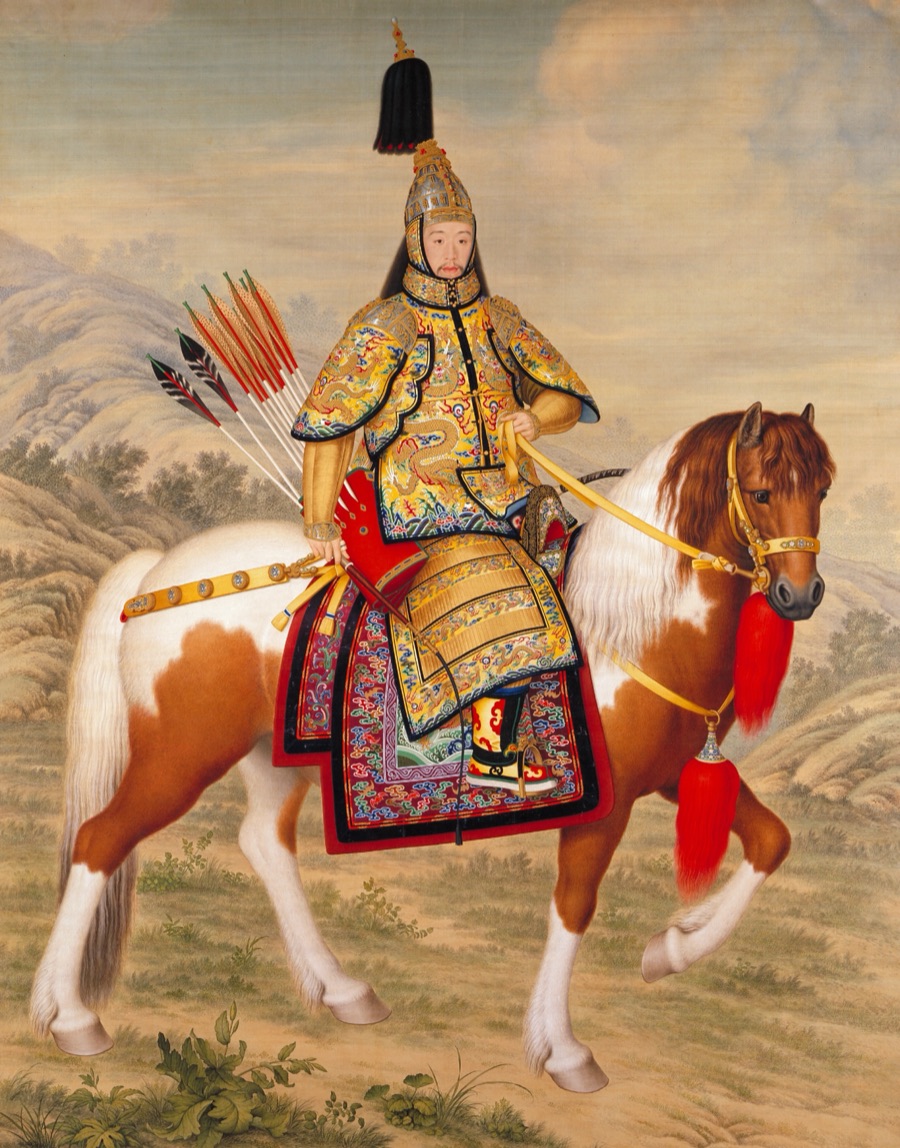
Kangxi's grandson, aged twenty-eight. Giuseppe Castiglione, The Qianlong Emperor in Ceremonial Armour on Horseback, 1739. Armour, bow and quiver: this is Qianlong at the Nanyuan military review in the fourth year of his reign. Palace Museum, Beijing · public domain.
朕幼年習射,□舊人教射者斷不以朕射為善,諸人皆稱曰善,彼獨以為否,故朕能騎射精熟。爾等甚不可被虛意承順讚美之言所欺。
"When I learned to shoot as a boy, the old retainer who taught me never once called a shot of mine good. Everyone else said good; he alone said no. That is why my riding and shooting became expert. Never let yourselves be taken in by hollow, obliging praise." One character in the library's text is illegible; it is reproduced as it stands.
— 《聖祖仁皇帝庭訓格言》 Maxims from the Kangxi Emperor's Family Instructions · found in 1 book
III. Competence
質 — Chulong to the Queen Dowager: if you do not let your son earn merit, you are ruining him
Qin attacked Zhao. Zhao asked Qi for help, and Qi set a price: send the Queen Dowager's youngest son, the Lord of Chang'an, as a hostage. She refused. When the ministers pressed her she announced that she would spit in the face of the next man who raised it.
Chulong, a senior minister, came to see her. He talked about his bad foot, about his appetite, and then said: my own youngest, fifteen, is good for nothing, and I am getting old; I would like you to take him into the palace guard. Men love their youngest too? she asked. More than women do, he said. Then he asked which she loved more, her daughter the Queen of Yan or the Lord of Chang'an.
And he made his case. Since Zhao became a state, how many sons and grandsons of its rulers have been enfeoffed — and how many of those houses still stand? None. Not because they were all bad men, but because they held "high rank without merit and rich stipends without labour," and sat on piles of treasure. You have given the Lord of Chang'an rank, fat land and treasure, and you have not used the time you have left to let him earn merit for the state. The day you are gone, what will he stand on in Zhao?
The Queen Dowager said: do as you think best. The boy went to Qi; Qi sent its army.
父母之愛子,則為之計深遠。
"Parents who love a child plan far ahead for him."
— 《戰國策·趙策四》 Strategies of the Warring States, compiled 1st c. BCE · found in 18 books
位尊而無功,奉厚而無勞,而挾重器多也。今媼尊長安君之位,而封之以膏腴之地,多予之重器,而不及今令有功於國。一旦山陵崩,長安君何以自托於趙?
"High rank without merit, rich stipend without labour, and a great hoard of treasure in hand. Now you give the Lord of Chang'an rank, fat land and treasure, and do not use this moment to let him earn merit for the state. When the mountain falls, what will he have to stand on in Zhao?"
— 《戰國策·趙策四》 Strategies of the Warring States · found in 33 books
刀 — Zichan: he cannot hold a knife yet, and you want him to carve
Zipi, head of government in Zheng, wanted to give a young man named Yin He a town to run. Zichan said he was too young. Zipi said: he is honest, I like him, he will not turn on me; let him go and learn on the job.
Zichan said: to love a man is to want good for him. You love this one, so you hand him government — that is like a man who cannot yet hold a knife being told to carve; he will only cut himself. Then came the sentence that has lasted two and a half thousand years: I have heard of learning and then entering office. I have never heard of using office to learn.
僑聞學而後入政,未聞以政學者也。……譬如田獵,射御貫則能獲禽,若未嘗登車射御,則敗績厭覆是懼,何暇思獲?
"I have heard of studying and then entering government; I have not heard of using government to study. … It is like the hunt: a man practised at shooting and driving brings down game. One who has never been up in a chariot is too busy fearing a crash to think of the quarry."
— 《左傳·襄公三十一年》 Zuo Tradition · found in 101 books
藝 — Deng Yu's thirteen sons, one skill each
Deng Yu was the first of Emperor Guangwu's founding generals, head of the list of twenty-eight, Marquis of Gaomi with four counties for his fief. Once the empire was settled he kept away from power and fame. He had thirteen sons and had each one master a single skill. The family lived on the income of the fief and did not go into business.
The Book of the Later Han says his household "kept its gates in order and raised its children in a way that could serve as a model for later ages." Six hundred years later Gu Yanwu singled this out in his Record of Daily Knowledge as the type of the Eastern Han founding families.
有子十三人,各使守一藝。修整閨門,教養子孫,皆可以為後世法。資用國邑,不修產利。
"He had thirteen sons and had each keep to one art. He kept his household in order and raised his children so as to be a model for later generations. He lived on his fief and did not pursue profit."
— 《後漢書·鄧禹傳》 Book of the Later Han, 5th c. · found in 17 books
令 — Cao Cao's order: being loved as a child counts for nothing; I use the one who grows up able
Cao Cao issued an order that later generations called the Order Concerning My Sons. Shouchun, Hanzhong and Chang'an, he said — I mean to send a son to take charge of each, and I want the ones who are filial and obey my orders; I do not yet know which.
兒雖小時見愛,而長大能善,必用之。吾非有二言也,不但不私臣吏,兒子亦不欲有所私。
"A son may have been loved as a child, but it is the one who grows up capable whom I will use. I do not say one thing and mean another: I show no favour to my officials, and I will show none to my sons."
— 《太平御覽》 Taiping Imperial Encyclopaedia, 983, quoting Cao Cao's order · found in 1 book
Three strategic cities on the table; who goes is decided by performance. It was an open competition.
遠 — Confucius did not teach his own son
A disciple, Chen Kang, asked Confucius's son Boyu: has the master ever taught you anything privately? No, said Boyu. Only twice. Once my father was standing alone in the courtyard and I hurried past; he asked, have you studied the Odes? No. If you do not study the Odes you cannot speak. So I went and studied the Odes. Another time: have you studied the Rites? No. If you do not study the Rites you cannot stand. So I went and studied the Rites.
Chen Kang came away pleased: I asked one thing and learned three — study the Odes, study the Rites, and a gentleman keeps his distance from his own son.
Mencius turned this into a principle. Teaching has to be done with correctness; when the child falls short the father grows angry, and anger between father and son wounds them both. So the ancients swapped sons and taught each other's.
Xie An's wife asked him: why do I never see you teaching the children? Xie An said: I am always teaching them — with myself.
古者易子而教之,父子之間不責善。責善則離,離則不祥莫大焉。
"The ancients exchanged sons and taught them. Between father and son there is no demanding of goodness. Demand it, and they grow apart; nothing is more unlucky than that."
— 《孟子·離婁上》 Mencius, 4th c. BCE · found in 80 books
謝公夫人教兒,問太傅:那得初不見君教兒?答曰:我常自教兒。
"Lord Xie's wife was teaching the children and asked the Grand Tutor: how is it I never see you teach them? He answered: I am always teaching them, by myself."
— 《世說新語·德行》 A New Account of Tales of the World, 5th c. · found in 12 books
友 — Jingjiang takes one look at her son's friends
The spinning mother again. Her son Wenbo came home from school and she watched. She saw his friends go down from the hall by the back steps walking backwards, carrying his sword and straightening his shoes, serving him as if he were their father or elder brother. Wenbo was pleased with himself: I am a grown man now.
Jingjiang called him in and dressed him down. King Wu, Duke Huan of Qi, the Duke of Zhou — which of them did not seek out men better than himself? You are young and your rank is low, and everyone you spend time with is there to wait on you. You will make no progress; that much is obvious.
Wenbo apologised. From then on he sought out strict teachers and worthy friends and served them; the men he kept company with were grey-haired elders, and he served them their food himself. Jingjiang said: now you are a man.
今以子年之少而位之卑,所與遊者,皆為服役。子之不益,亦以明矣。
"You are so young and your rank so low, and those you keep company with are all your servants. That you will not improve is plain."
— 《列女傳·母儀》 Biographies of Exemplary Women, 1st c. BCE · found in 7 books
IV. Do it the other way round, and the ending is already written
寵 — Shi Que: pride, extravagance, licence and idleness all come from indulgence
Duke Zhuang of Wey doted on Zhou Xu, a son by a concubine. Zhou Xu loved to play with weapons and the duke did nothing. The minister Shi Que remonstrated with him in what is China's earliest theory of spoiling.
臣聞愛子,教之以義方,弗納於邪。驕、奢、淫、泆,所自邪也。四者之來,寵祿過也。
"I have heard that to love a son is to teach him the right way and keep him from crookedness. Pride, extravagance, licence and idleness are where crookedness begins. And where do those four come from? Too much favour, too much given."
— 《左傳·隱公三年》 Zuo Tradition · found in at least 41 books
The duke did not listen. Zhou Xu later murdered his half-brother the duke and took the throne. Shi Que had him killed by stratagem — and had his own son, who had run with Zhou Xu, killed with him.
獄 — What Zhao Gao taught Huhai was how to cut people up
Jia Yi, trying to explain why the Zhou lasted and the Qin did not, put the answer in the education of the heir.
A Zhou crown prince was surrounded from birth by upright men: "living among the upright, he could not help but be upright," as a child raised in Qi could not help speaking the Qi dialect. Once grown he had a historian to record his faults, an official to cut his meals, a drum anyone could beat to remonstrate — criticised every day, so that "habit grew with wisdom, and the shaping grew with the heart."
And Qin? Zhao Gao was made tutor to Huhai and taught him the law courts: all he learned was beheading, nose-slitting and the extermination of clans.
使趙高傅胡亥而教之獄,所習者非斬劓人,則夷人之三族也。故今日即位,明日射人。
"Zhao Gao was made Huhai's tutor and taught him criminal cases; what he practised was either beheading and slitting noses or wiping out three generations of a family. So he took the throne one day and was shooting people the next."
— 賈誼《新書·保傅》 Jia Yi, New Writings, 2nd c. BCE · found in 53 books
Jia Yi's conclusion: Huhai was not born evil; the men who taught him and the things they taught were wrong. "Habit grows with wisdom, the shaping grows with the heart" — eight characters that are the Han summary of aristocratic education.
習與智長,故切而不愧,化與心成,故中道若性。
"Habit grows together with wisdom, so he is corrected without shame; the shaping grows together with the heart, so walking the right way seems his nature."
— 賈誼《新書·保傅》 Jia Yi, New Writings · found in 113 books
粉 — The young lords of Liang: perfumed, powdered, and mistook a horse for a tiger
Yan Zhitui lived through the fall of the Liang dynasty and wrote down what he saw.
At the height of the Liang, he says, hardly any sons of the great houses had any learning. There was a jingle: "if you can get into a carriage without falling off, you can be an Editor; if you can write 'how is your health,' you can be a Secretary." They perfumed their clothes, shaved their faces, powdered and rouged, rode in long-eaved carriages, wore high-toothed clogs, and from a distance looked like immortals.
Then the Hou Jing rebellion came. These men, "soft of flesh and weak of bone, unable to walk, frail and short of breath, unable to bear heat or cold," died in large numbers in the scramble to flee.
A magistrate of Jiankang named Wang Fu had never once ridden a horse. Seeing one neigh and rear, he said in terror: this is plainly a tiger — why do they call it a horse?
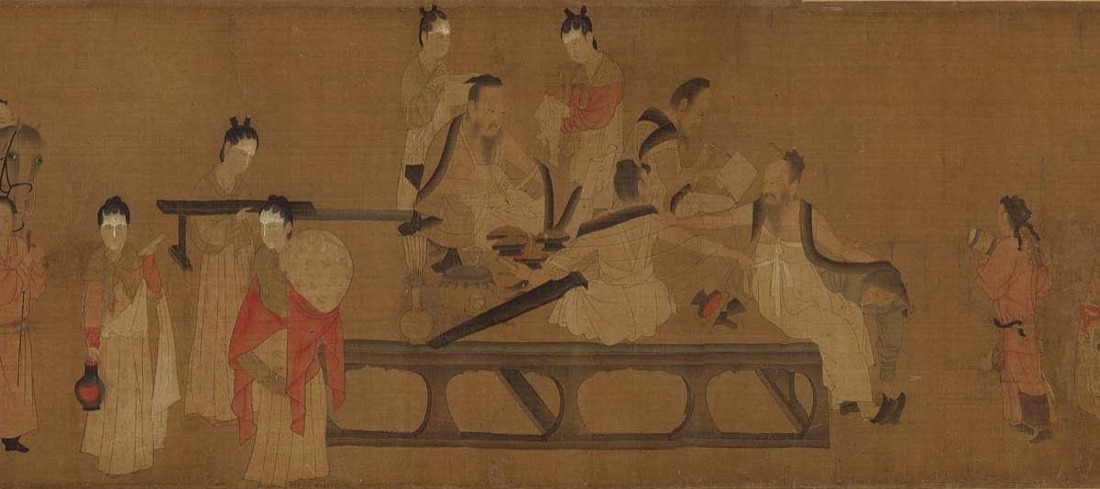
What Yan Zhitui saw every day. Northern Qi Scholars Collating Classic Texts, Song copy, detail. Scholars of the Northern Qi on a couch, robes loosened, attendants all round them. Yan Zhitui served the Northern Qi for twenty years. Museum of Fine Arts, Boston · public domain.
及離亂之後,朝市遷革……求諸身而無所得,施之世而無所用。被褐而喪珠,失皮而露質,兀若枯木,泊若窮流。
"Then came the upheaval; court and market changed hands … They looked inside themselves and found nothing, offered themselves to the world and were of no use. Like paupers who had lost their pearl, like animals stripped of their hide — stiff as dead wood, thin as a river running dry."
— 顏之推《顏氏家訓·勉學》 Family Instructions of the Yan Clan, c. 590 · found in at least 57 books
建康令王復性既儒雅,未嘗乘騎,見馬嘶歕陸梁,莫不震懾,乃謂人曰:正是虎,何故名為馬乎?
"Wang Fu, magistrate of Jiankang, was a refined man who had never ridden. Whenever he saw a horse neigh and rear he was terrified, and said: that is clearly a tiger — why do they call it a horse?"
— 顏之推《顏氏家訓·涉務》 Family Instructions of the Yan Clan · found in at least 2 books
The rules Yan Zhitui set for his own children were the exact opposite. "Teach a wife the day she arrives; teach a child in the cradle." Start in infancy; by a few years old the child must "do when told to do and stop when told to stop." Parents must be stern and loving at once. His example: Grand Marshal Wang Sengbian, past forty and commanding three thousand men, was still beaten by his mother when she was displeased — which, Yan says, is why he achieved what he did.
教婦初來,教兒嬰孩。
"Teach the bride when she first comes; teach the child while it is a baby."
— 顏之推《顏氏家訓·教子》 Family Instructions of the Yan Clan, quoting a proverb · found in 37 books
冰 — A ten-year-old prince throws a tantrum over ice
Yan Zhitui also recorded a cautionary case. The Prince of Langya, son of Emperor Wucheng of Northern Qi and full brother of the heir, was adored by both parents and given everything the heir had. At about ten, attending court, he saw the imperial kitchen bring the emperor fresh ice and the orchards send in early plums. He asked for the same, did not get it, and exploded: the emperor has it — why not me? Later he took a dislike to the chancellor, forged an edict and had him executed, and ended his own life under house arrest.
A century and more later Sima Guang, in his Family Models, boiled cases like this down to one sentence.
為人母者,不患不慈,患於知愛而不知教也。古人有言曰:慈母敗子。
"The trouble with mothers is not that they lack love. It is that they know how to love and not how to teach. As the ancients said: a doting mother ruins the son."
— 司馬光《家範》 Sima Guang, Family Models, 11th c. · found in 1 book
What changed in three thousand years, and what did not
A dozen dynasties came and went, and the method barely moved: make him suffer first, then put him in danger, then make him earn his place with real competence instead of inheriting it from his father.
The Duke of Zhou said "first know how hard it is to sow and reap." Zhu Yuanzhang said "learn how hard food and clothing come." Kangxi said "one who cannot bear hardship is useless anywhere." Chulong said rank without merit is the seed of ruin; Cao Cao said he would use the son who grew up able. Two thousand years apart, it is one sentence.
Mencius had already said the hard part. "When Heaven is about to lay a great charge on a man, it first embitters his heart and wearies his bones" — everyone knows that line. Fewer know the one he added in Jin Xin: the men who end up with virtue, wisdom and skill are usually the ones who grew up in trouble. Only the neglected minister and the son of a concubine worry deeply enough and look far enough ahead to break through.
人之有德慧術知者,恆存乎疢疾。獨孤臣孽子,其操心也危,其慮患也深,故達。
"Those who possess virtue, wisdom, skill and knowledge have usually been through affliction. It is the isolated minister and the son of the concubine, whose hearts are anxious and whose fear of trouble runs deep, who get through."
— 《孟子·盡心上》 Mencius · found in 151 books
That is the whole difficulty of raising a noble child: he is, by birth, neither the neglected minister nor the concubine's son. So the hardship has to be manufactured — the danger, the toil, the situation where no one will do it for him. Every one of the twenty-odd items above is a way of manufacturing it.
How these were checked
Every classical line on this page was searched, character by character, against a library of 15,694 classical Chinese books — roughly two billion characters — at cn.jic.io. The count beside each source is how many separate books in that library contain the exact sentence.
That number is not a measure of truth; it is a measure of transmission. "First know how hard it is to sow and reap" turns up in over a hundred books because every generation that taught an heir copied it. Cao Cao's order to his sons survives in a single encyclopaedia — one thread. Where the count says "at least," the candidate list was too long to verify book by book (we stopped at 900), so the true number is higher.
The library's texts are in simplified characters, partly unpunctuated and, by its own notice, "entered collaboratively over many years and never systematically collated." Quotations are given here in traditional characters with punctuation added; check a critical edition before citing formally.
What could not be verified was left out:
- Kangxi's "I read every book a hundred and twenty times" — not in the library's Family Instructions.
- The Records of the Grand Historian story of Zhao Jianzi hiding a treasure tally on Mount Chang — the passage could not be retrieved from the library's text, only a four-character echo in a later commentary, so the bamboo-slip version from the Zizhi Tongjian is used instead.
- Zhu Yuanzhang making his sons walk three-tenths of every journey in hemp sandals — not in the Veritable Records, the History of Ming or the Precious Instructions; probably a later retelling.
- Confucius never says why he kept his distance from his son. "The ancients exchanged sons" is Mencius's explanation, not his.
Images: The Kangxi Emperor Reading (Palace Museum, Beijing), Pictures of Tilling and Weaving (British Museum), Khubilai Khan Hunting (National Palace Museum, Taipei), The Qianlong Emperor in Ceremonial Armour (Palace Museum, Beijing), Northern Qi Scholars Collating Classic Texts (Museum of Fine Arts, Boston), The Yongzheng Emperor Reading, and the Summer Palace panel of Zhang Liang (photo by shizhao) are all in the public domain. All via Wikimedia Commons.