
Nobody Sat in Chairs
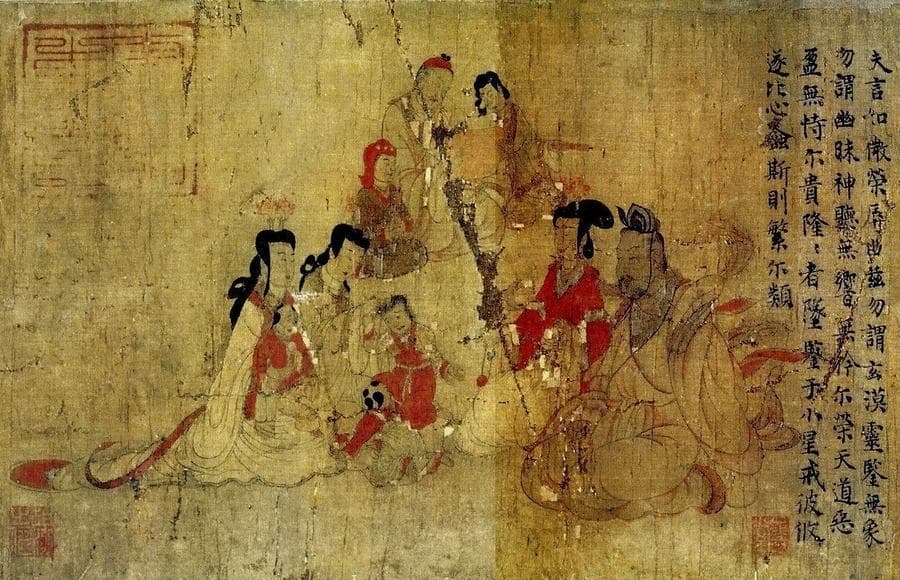
Table of Content
- 席 — For most of Chinese history, there were no chairs
- 箸 — Chopsticks were a soup tool
- 鹽 — Tea was salted, and whisked like soup
- 冰 — Cold drinks in summer, three thousand years ago
- 沐 — The word for "day off" means "wash your hair"
- 紙 — Toilet paper in the 6th century, proved by a ban on it
- 髮 — Cutting your hair was a criminal punishment
- 纏足 — Bound feet are not ancient, and a Song writer already said so
- How these were checked
Eight small, physical facts about old China — the kind you would notice in the first ten minutes if you walked in. Each one comes with the sentence it comes from, in the original, so you can see it is not invented.
席 — For most of Chinese history, there were no chairs
You picture Confucius seated at a table.
He was not. For roughly the first two thousand years of recorded Chinese life, people knelt or sat on woven mats on the floor, with low tables in front of them — the way a formal Japanese room still works today, because Japan borrowed the arrangement and kept it.
The chair arrived from the north-west as foreign furniture, and its early name says so plainly: 胡床, the "barbarian bed." Around the year 180 the emperor took a liking to foreign things, the capital's aristocracy copied him, and the seat slowly climbed off the floor. It took another eight centuries to become normal.
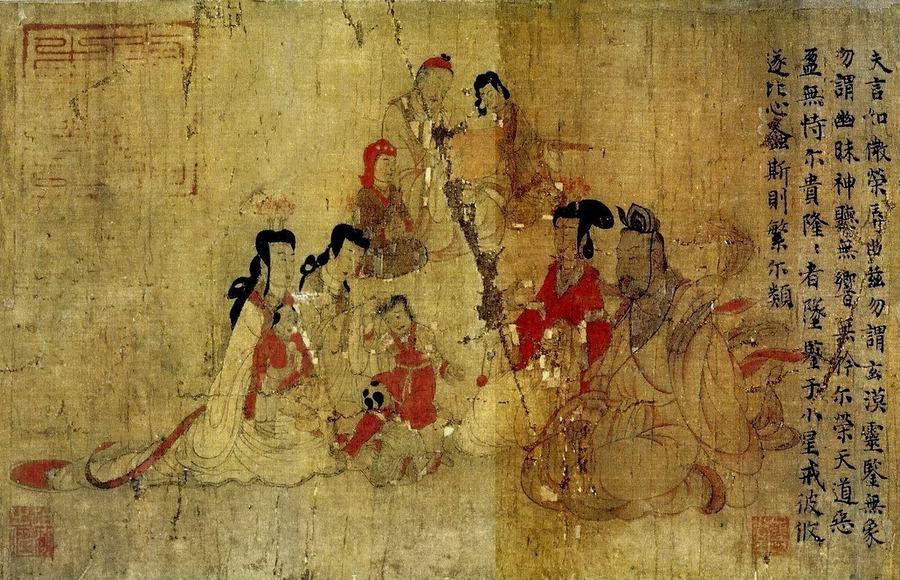
Before — everyone is on the floor. 《女史箴圖》 Admonitions Scroll, detail. Adults and children all seated at ground level; there is no chair anywhere in the painting. British Museum · public domain.
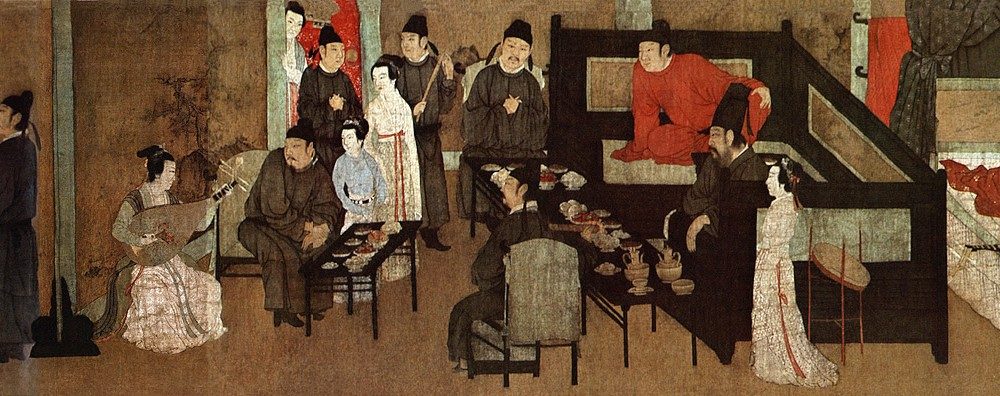
After — the chair has landed. 《韓熙載夜宴圖》 Night Revels of Han Xizai, detail, 10th century. High-backed chairs, a bench, raised tables, feet on the ground. Palace Museum · public domain.
靈帝好胡床
"Emperor Ling was fond of the barbarian bed." He was fond of foreign clothes and foreign tents too; the court followed his taste.
— 《後漢書》 History of the Later Han, 5th c. · found in 5 books
箸 — Chopsticks were a soup tool
You assume chopsticks were always how food got eaten.
They were not the main utensil. Grain — millet, then rice — was eaten with a spoon. Chopsticks had one job: fishing the solid bits out of a bowl of soup. The ritual manual is specific about it, the way a rulebook is specific about which fork.
So the correct ancient table setting is a spoon for the staple and chopsticks for the stew. Chopsticks only became the general-purpose tool much later, as stir-frying and rice-in-a-bowl took over the meal.
羹之有菜者用梜
"For soup that has vegetables in it, use chopsticks." 梜 is the older word; 箸 and today's 筷子 came later.
— 《禮記·曲禮》 Book of Rites, compiled by 1st c. BCE · found in 13 books
鹽 — Tea was salted, and whisked like soup
You imagine an unbroken three-thousand-year tea ceremony.
The classic manual on tea, written in the 8th century, tells you to watch for the first boil and then season the water with salt. Tea at that time was a pressed cake: you roasted it, ground it to powder, boiled it, salted it, and drank the whole suspension. Ginger, orange peel and other things went in too, and the author complains about people who overdo it.
Dropping loose leaves into hot water and letting them steep — what almost everyone now pictures as "Chinese tea" — is a Ming dynasty habit. It is about six hundred years old, not three thousand.
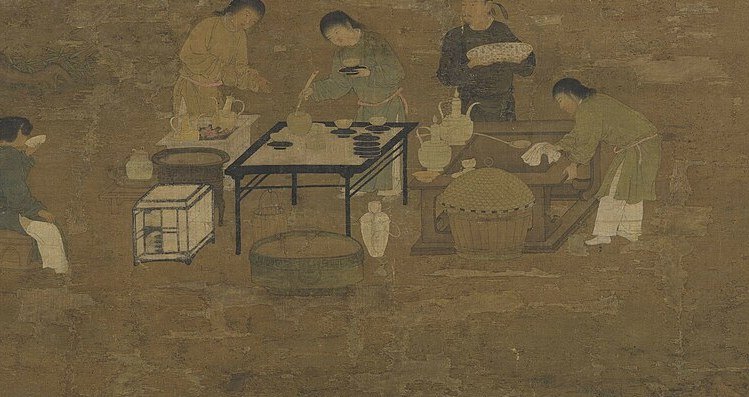
A tea station, not a teapot. 《文會圖》 Literary Gathering, attributed to Emperor Huizong, detail. A charcoal stove, a ewer, water jars, and rows of dark bowls waiting to be whisked. This is the Song version of the same tradition — still powdered, still whisked, still not steeped leaves. National Palace Museum, Taipei · public domain.
調之以鹽味
"Season it with salt." From the instructions for the first boil.
— 陸羽《茶經》 The Classic of Tea, c. 760 · found in 1 book
冰 — Cold drinks in summer, three thousand years ago
You assume ice was a modern luxury.
One of the oldest poems in the language is a farming calendar that runs month by month through the year's work. Two of its lines are an ice schedule: in deep winter you go out and cut the river ice, and in the next month you pack it into the cellar. It kept until summer, and the court drank cold.
The word in that second line — 凌陰, the "ice shade" — is a purpose-built underground store. Archaeologists have since dug them up.
二之日鑿冰沖沖,三之日納于凌陰
"In the second month, chip the ice, chong chong; in the third month, bring it into the ice cellar." Chong chong is the sound of the chisel.
— 《詩經·豳風·七月》 Book of Songs, c. 1000–600 BCE · found in 38 books
沐 — The word for "day off" means "wash your hair"
You assume weekends are a Western invention that arrived with factories.
Officials of the Han dynasty, two thousand years ago, got one day in five to go home. The name for it was 休沐 — literally "rest and wash." Not a metaphor: everyone had long hair that was never cut (see below), pinned up all day under a cap, and washing it was a genuine half-day operation.
So the oldest Chinese word for a public holiday is, at root, a hair-washing appointment.
每五日洗沐歸謁親
"Every fifth day he went home to wash and to pay respects to his parents."
— 《漢書·萬石君傳》 Book of Han, 1st c. · found in 33 books
紙 — Toilet paper in the 6th century, proved by a ban on it
You assume toilet paper is Victorian.
A scholar writing family instructions around the year 590 lays down a rule for his sons: any sheet of scrap paper carrying words of the Classics, or the name of a worthy man, must never be put to filthy use.
Read that rule backwards and you have your evidence. You do not forbid something nobody does. Ordinary paper was being used in the privy in 6th-century China, and the only question in the house was which sheets were off-limits. Mass-produced toilet paper reaches the West in the 1850s — about thirteen hundred years later.
有五經詞義及賢達姓名,不敢穢用也
"[Paper] bearing the wording of the Five Classics, or the names of worthy men — I dare not put it to filthy use."
— 顏之推《顏氏家訓》 Family Instructions of the Yan Clan, c. 590 · found in 11 books
髮 — Cutting your hair was a criminal punishment
You assume a haircut is just a haircut.
The single most quoted line of the classic on filial duty says your body, your hair and your skin were given to you by your parents, and you do not dare damage them. That is why men and women both wore their hair long and bound it up. A monk's shaved head was a visible break with family; a criminal's shaved head was the point of the sentence.
There was a specific penalty for it — 髡, head-shaving — which drew no blood and left no scar, and was still counted a serious punishment, because everyone could see it growing back.
身體髮膚,受之父母,不敢毀傷
"Body, hair and skin are received from your parents; you do not dare damage them."
— 《孝經》 Classic of Filial Piety, c. 3rd c. BCE · found in 12 books
纏足 — Bound feet are not ancient, and a Song writer already said so
You picture bound feet as a constant of Chinese history.
They are not. Foot-binding appears around the 10th or 11th century. We can say this with unusual confidence because a writer living in the 12th century — close enough to still be curious about it — flatly records that the practice among women "arose in recent times," and that he could find nothing about it in earlier books.
So for something like two-thirds of recorded Chinese history it simply did not exist, and when it did it was never universal — it varied sharply by region, class and ethnicity. It should not be softened into a curiosity: it broke the bones of small girls, took years, and was done to them. It was outlawed in the 20th century, and the last women who had it done are dying now.
The long cotton strip used for the binding, the 裹腳布, outlived the practice — as an insult. To this day a Chinese speaker can dismiss a piece of bloated, going-nowhere writing by calling it "a lazy woman's foot-binding cloth: long, and it stinks."
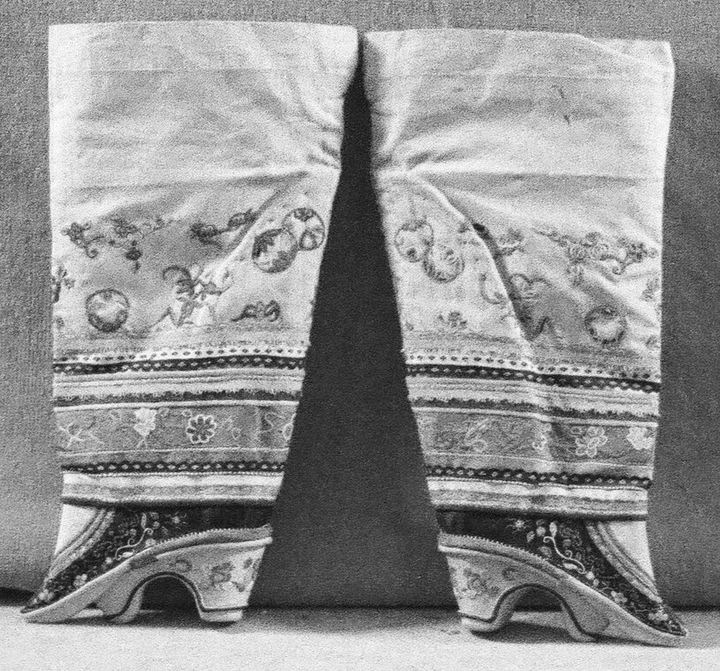
The shoes, catalogued. A pair of embroidered lotus shoes with leggings, c. 1860. Photographed as a museum object, with its accession number and scale bar. The scale is the point. Wikimedia Commons · CC BY.
婦人之纏足,起於近世
"Women's foot-binding arose in recent times."
— 張邦基《墨莊漫錄》 Southern Song, 12th c. · found in 3 books
The "lazy woman's cloth" saying is modern spoken Chinese, not a classical source, and is marked here as such.
How these were checked
Every classical line on this page was searched, character by character, against a library of 15,694 classical Chinese books — roughly two billion characters — at cn.jic.io. The count beside each source is how many separate books in that library contain the exact sentence.
That number is not a measure of truth; it is a measure of transmission. A line that appears in thirty-eight books was copied, quoted and argued over for centuries. A line that appears in one survives in a single thread.
Anything that could not be verified is either left out or labelled, like the modern saying at the end. Nothing here is paraphrased from memory.
Images: Admonitions Scroll (British Museum), Night Revels of Han Xizai (Palace Museum) and Literary Gathering (National Palace Museum, Taipei) are in the public domain. The lotus shoes are reproduced under CC BY. All via Wikimedia Commons.