
An Analysis of Blockchain Cross-Chain Technology
An Analysis of Blockchain Cross-Chain Technology
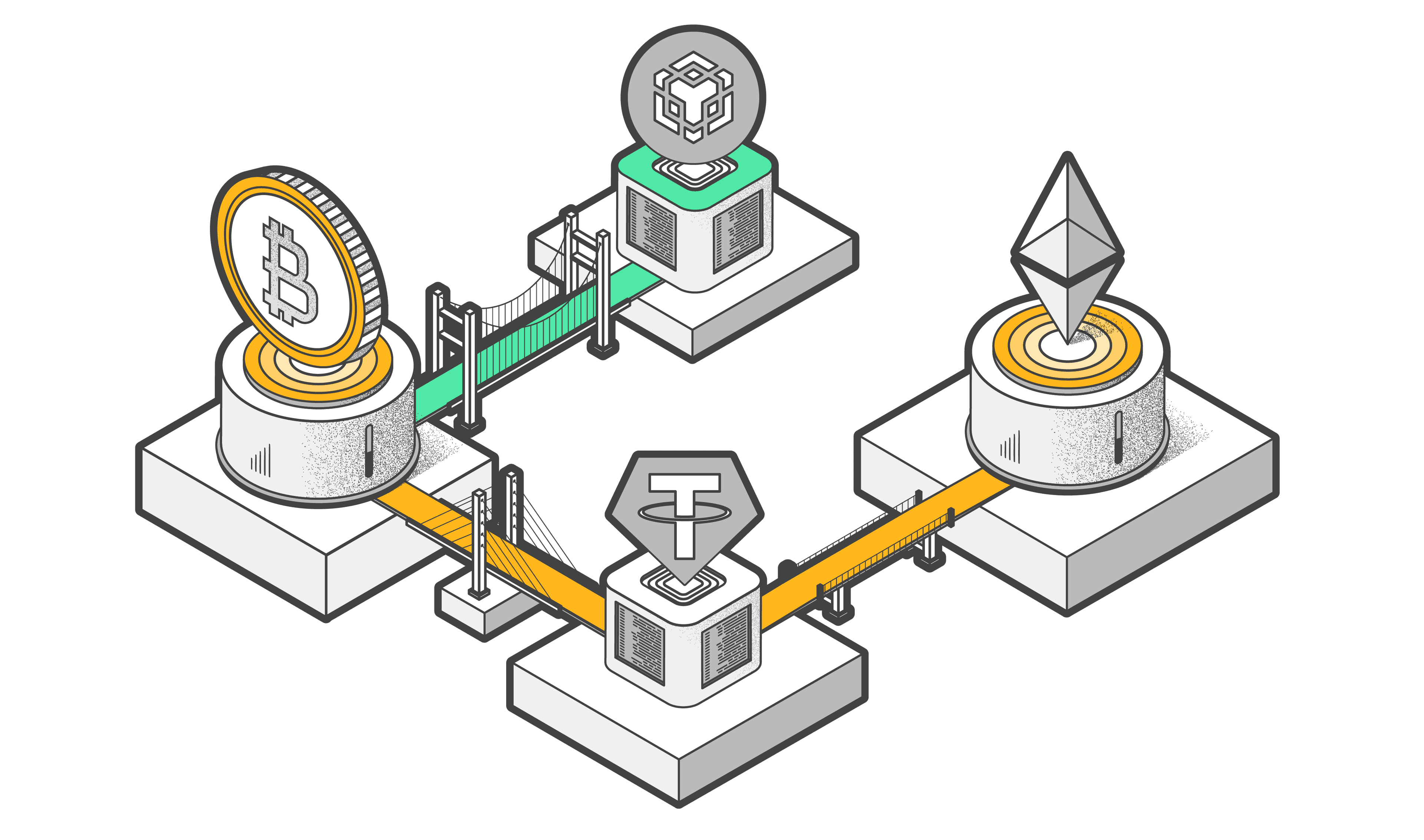
Among the many problems blockchains face — whether Bitcoin (Blockchain 1.0) or Ethereum (Blockchain 2.0) — the lack of interoperability between chains has hugely limited blockchain's application space. For both public and private chains, cross-chain technology is the key to realizing the Internet of Value. It is the cure that rescues blockchains from being scattered islands, and the bridge for a chain to expand and connect outward.
Today's mainstream cross-chain approaches include:
1. Notary schemes
2. Sidechains / relays
3. Hash-locking
4. Distributed private key control
A comparison table:
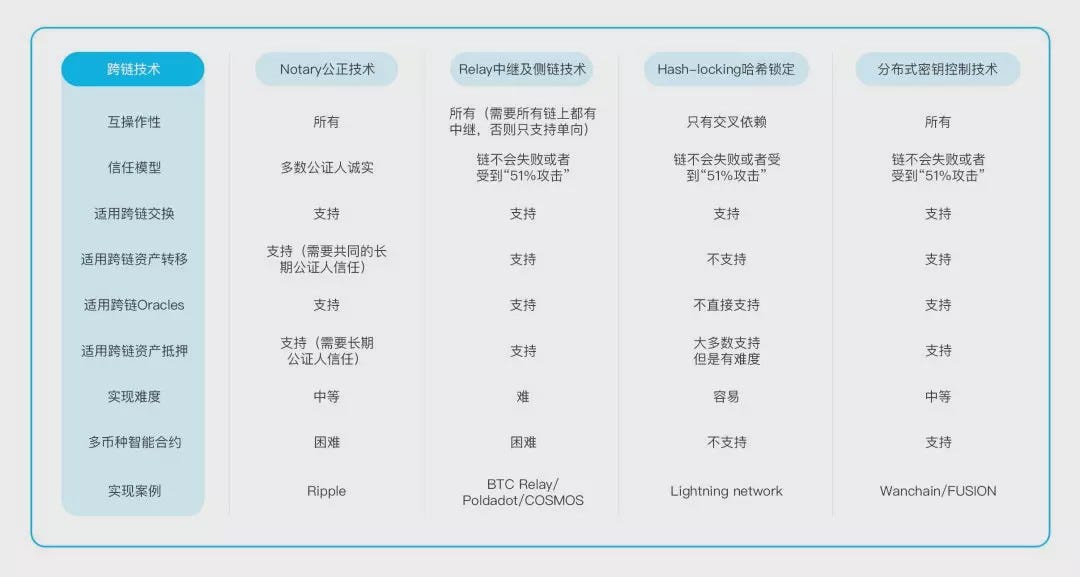
The table above lays out the basic differences among the various cross-chain technologies. Early cross-chain tech, represented by Ripple and BTC Relay, focused more on asset transfer; current cross-chain tech, represented by Polkadot and Cosmos, focuses more on cross-chain infrastructure; FUSION implements cross-chain technology for mainstream blockchains, supporting multi-currency cross-chain smart contracts, on top of which rich cross-chain financial applications can emerge.
1. Notary technology: Ripple's Interledger protocol
Back in 2012, Ripple Labs proposed the Interledger protocol to connect different ledgers and enable coordination between them. Interledger applies to all ledger systems and can accommodate their differences; its goal is to build a unified global payment standard and create a unified protocol for networked financial transfer.
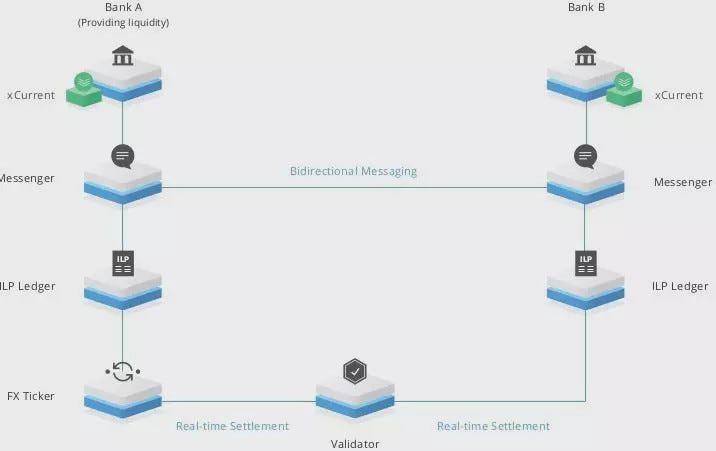
Interledger lets two different ledger systems freely transfer money to each other through a third-party "connector" or "validator." The ledgers need not trust the connector, because the protocol uses cryptographic algorithms to create escrow between the two ledgers via the connector; once all parties reach consensus on the transaction, they can trade. The protocol removes the trust required between participants — the connector cannot lose or steal funds — which means such transactions need no legal contracts or heavy auditing, greatly lowering the barrier. At the same time, only the participating ledgers can track the transaction, and its details can be hidden; the "validator" runs via cryptographic algorithms and so cannot directly see the details. In theory the protocol is compatible with any online ledger, and banks' existing ledgers need only small changes to use it — letting banks trade directly without a central counterparty or correspondent bank.
2. Sidechain technology: BTC Relay
A sidechain is a new kind of blockchain anchored to some token on an original chain, just as the dollar was anchored to gold. Sidechains connect various chains, while the other chains can exist independently. But sidechains today struggle to build cross-chain smart contracts on top of themselves, making financial functions hard to implement — which is exactly why existing blockchains have made little progress in stocks, bonds, derivatives, and the like.
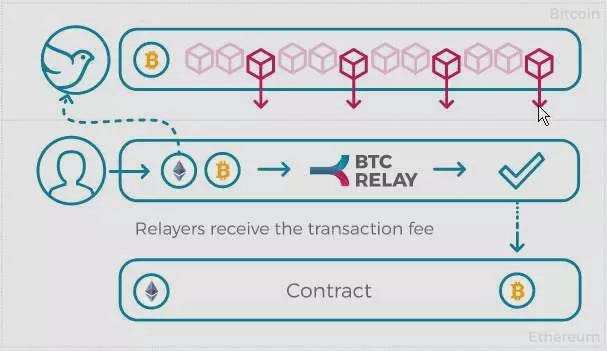
BTC Relay was born and grew with the support of the Ethereum Foundation, and is considered the first sidechain on a blockchain. BTC Relay links the Ethereum and Bitcoin networks using Ethereum smart contracts, letting users verify Bitcoin transactions on Ethereum. It creates a miniature version of the Bitcoin chain via an Ethereum smart contract, but the contract needs to fetch Bitcoin network data, which is still hard to decentralize. BTC Relay was a meaningful attempt at cross-chain communication, opening a channel between different chains.
3. Relay technology: Polkadot and Cosmos
Polkadot
Polkadot is a public chain launched by a former lead Ethereum core developer. It aims to solve two of today's biggest obstacles to blockchain's spread and adoption: instant scalability and extensibility. Polkadot plans to fold private/consortium chains into a public-chain consensus network while preserving their original data privacy and permissioning. It can connect multiple blockchains.
In Polkadot's view, other blockchains are parachains. Via relay-chain technology, Polkadot can move tokens from an original chain into an address on that chain controlled like a multi-sig, locking them temporarily; the transaction result on the relay chain is decided by those signers' votes. It also introduces "fishermen" to report and police transactions. Through Polkadot, Bitcoin, Ether, and others can link to Polkadot for cross-chain communication.
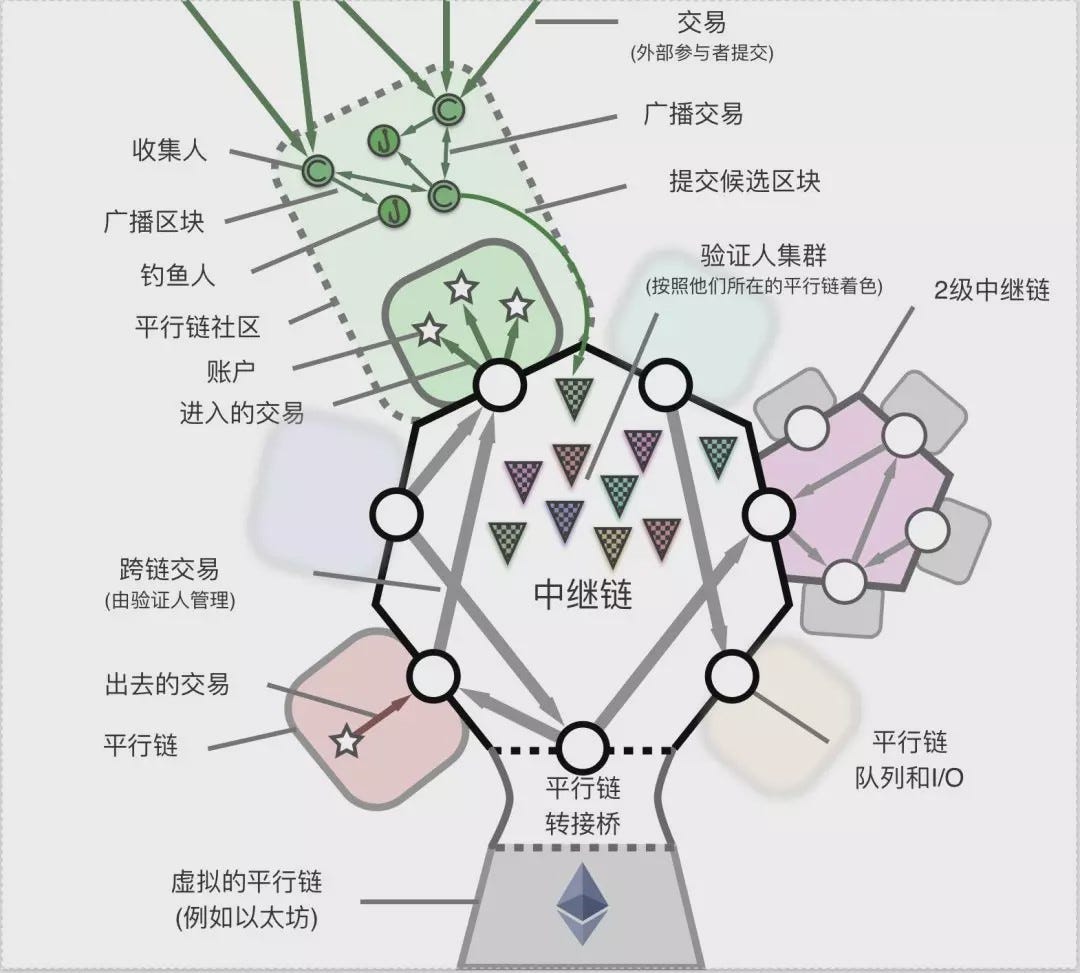
For now Polkadot still centers on Ethereum, connecting it with private chains, with other public-chain networks as upgrade targets — ultimately letting Ethereum communicate directly with any chain.
Cosmos
Cosmos is a heterogeneous network supporting cross-chain interaction, launched by the Tendermint team. Its Tendermint consensus algorithm is a practical-Byzantine-fault-tolerant-like consensus engine, with high performance and consistency; under its strict fork-accountability, it can prevent malicious participants from misbehaving.
The first "zone" on Cosmos is the "Cosmos Hub." The Cosmos Hub is a multi-asset proof-of-stake cryptocurrency network that handles changes and upgrades through a simple governance mechanism, and can scale by connecting to other zones.
The Cosmos Hub and its zones communicate via the Inter-Blockchain Communication (IBC) protocol — a protocol for blockchain networks, analogous to UDP or TCP. Tokens can move safely and quickly from one zone to another without needing exchange-rate liquidity between them. Instead, all token transfers within zones pass through the Cosmos Hub, which records the total tokens held by each zone. The Hub isolates each zone from any faulty zone. And because anyone can connect a new zone to the Hub, Cosmos is also compatible with future blockchains.
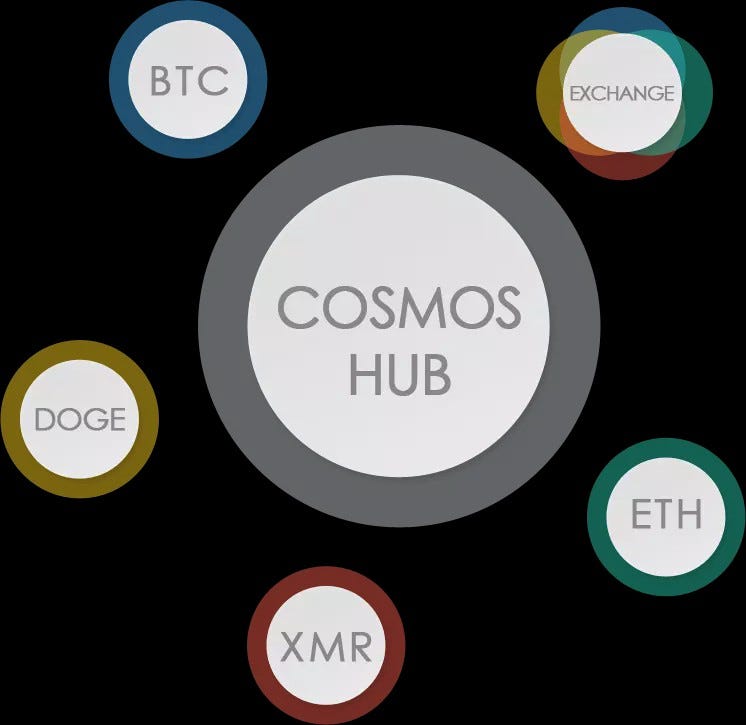
This architecture solves many of the problems blockchain faces today, including application interoperability, scalability, and seamless upgradeability. For example, zones derived from Bitcoind, Go-Ethereum, ZCash, or other blockchain systems can all connect to the Cosmos Hub. These zones let Cosmos scale infinitely to meet global transaction demand.
4. Hash-locking technology: the Lightning Network
The Lightning Network provides a scalable network of Bitcoin micropayment channels, greatly boosting Bitcoin's off-chain transaction capacity. If two parties have a pre-set payment channel on-chain, they can make rapid, repeated, high-frequency, bidirectional micropayments with fast confirmation; if they have no direct peer-to-peer channel, as long as the network contains a payment path of multiple channels connecting them, Lightning can use that path to reliably move funds between them. Lightning's key technology is the HTLC hash-lock, working roughly like this: Alice and Bob agree on a contract that locks Alice's 0.1 BTC; before time T (expressed as some future block height), if Bob can present Alice with an appropriate R (the "secret") whose hash equals the pre-agreed H(R), Bob gets the 0.1 BTC; if Bob fails to provide a correct R by time T, the 0.1 BTC automatically unfreezes and returns to Alice.
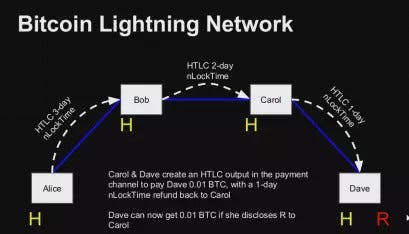
Lightning doesn't try to solve the single-payment problem; it assumes each payment is small enough that even a default causes the other party only a tiny, bearable loss. So when using it, keep the "micropayment" premise in mind.
5. Distributed private key control
WanChain
WanChain also supports cross-chain transactions among mainstream public chains, but first requires registration on WanChain so it can uniquely identify the chain. For cross-chain transactions, WanChain uses multi-party computation and threshold key-sharing schemes. When an unregistered asset moves from its original chain to WanChain, WanChain nodes use a protocol-based built-in asset template to deploy a new smart contract per the cross-chain info and create the new asset. When a registered asset moves over, WanChain nodes issue the user an equivalent token from an existing contract, ensuring the original-chain asset can still trade and circulate on WanChain.
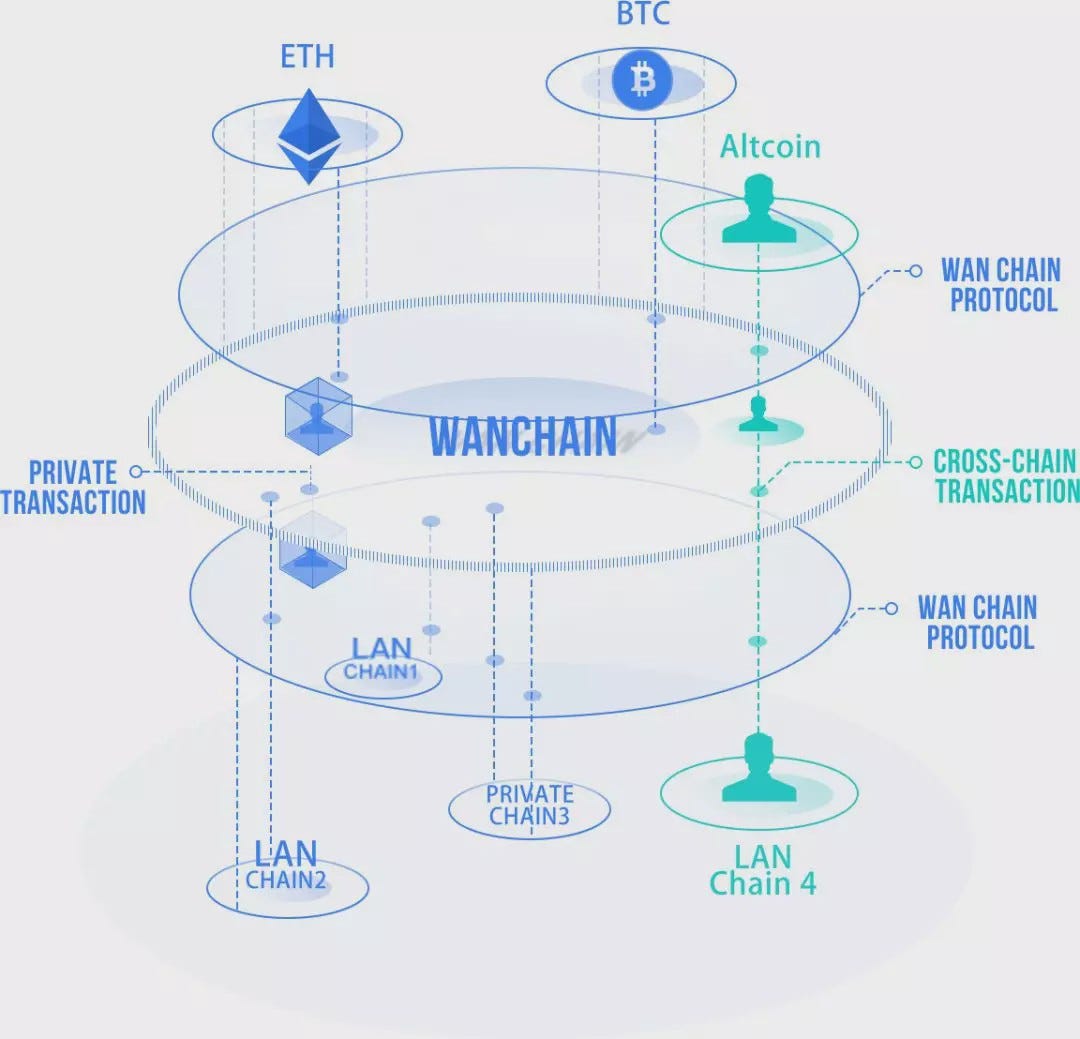
WanChain connects different blockchain ledgers and exchanges value in a distributed way. Using a general cross-chain protocol and a distributed ledger recording cross-chain and in-chain transactions, public, private, and consortium chains can all connect to WanChain to link ledgers and transfer assets across them.
But mapping various chains onto one chain is only the first step. If the smart contracts on top are still merely transaction-triggered — unable to do distributed computation and multi-trigger mechanisms — then multi-currency smart contracts remain quite limited in function.
FUSION
Various crypto assets can be mapped onto the FUSION public chain via distributed private-key generation and control. Multiple mapped assets can then interact freely on its public chain. The operations to establish and release distributed control are called Lock-in and Lock-out. Lock-in is the process of placing all key-controlled digital assets under distributed control and mapping them; Lock-out is the inverse, returning control to the owner.
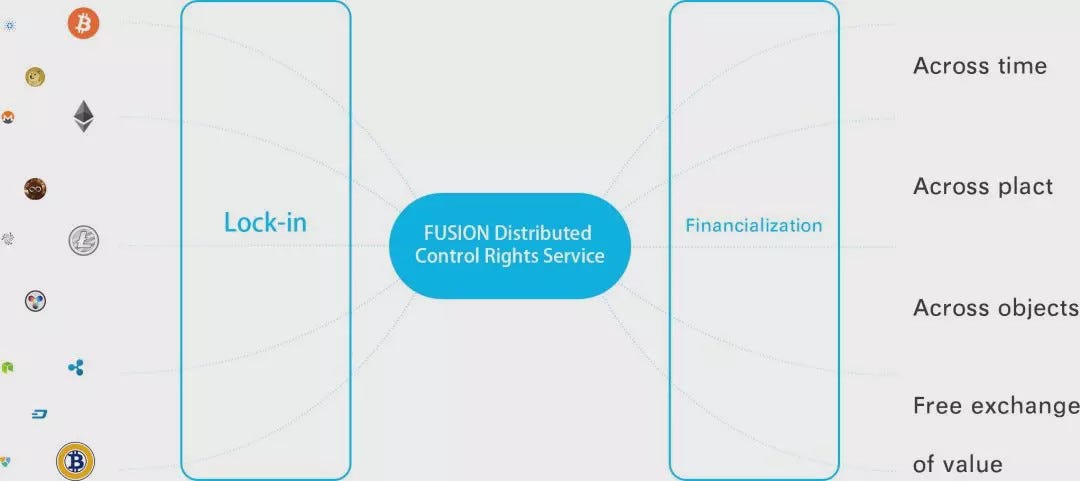
While supporting value transfer among various tokens, the FUSION protocol designed a "calling list" mechanism that stores trigger conditions separately from smart contracts; bookkeeping nodes only need to load the list of trigger conditions, loading the smart contract itself only when triggered. This lets transaction triggers, time triggers, and event triggers (including off-chain data triggers) all be written into the trigger list. Through a multi-layer consensus mechanism and grouping of bookkeeping nodes, a degree of parallel computation is achieved. The multi-layer mechanism completes contract computation and the recording of results in separate steps, and node grouping lets different smart contracts be handled by different node groups. FUSION innovates in parallel computation, off-chain data, and multi-trigger mechanisms, delivering efficient, enhanced smart contracts oriented toward multiple currencies and multiple trigger types.
After assets map to FUSION, their functions on the original chain are temporarily locked; on FUSION, enhanced smart contracts form rich crypto-financial applications that multiply their financial value. What FUSION does is crypto finance for the era of the Internet of Value.
The Future of Cross-Chain
For the Internet of Value to truly be a "net," it needs various cross-chain technologies to break through the LAN limitation of Blockchain 2.0. Cross-chain for a single chain is only the first step; a multi-chain network is the essence of cross-chain. Cross-chain lets tokens on various original chains circulate freely, but to achieve full financial functionality, smart contracts must also support cross-chain and use parallel computation for efficiency — enabling rich financial applications. That is the future direction of cross-chain technology.